










































Adapting social norms exploration approach to dig deep and co-design effective family planning and pregnancy prevention interventions with target beneficiaries in Uganda
Summary:
Adapting social norms exploration approach to dig deep and co-design effective family planning and pregnancy prevention interventions with target beneficiaries in Uganda Background: According to the 2016 Uganda demographic and health survey, 70% of the population is less than 25 years old. Uganda has seen a reduction in total fertility from 6.7 to 5.4 children per woman; an increase in modern contraception use, from 26% to 35%; and a reduction in unmet need for FP, from 34% to 28%. However, 25% of adolescents ages 1519 have begun childbearing, low/no schooling and child marriage is rampant. In June 2018, USAID/Advancing Partners and Communities project (APC) conducted a social-norms exploration to understand drivers of these negative practices, which would inform the design of context-specific interventions. Methods: APC opted for a qualitative, participatory exploratory approach and adapted the Passages Social Norms Exploration toolkit (My social-network, Influence mapping, Vignettes, Pocket-chart, problem tree and 5-whys) and focus group discussions. All data were analyzed by thematic content analysis. Results: The results showed that the main drivers of teenage pregnancy, child marriage and high fertility are not new and were clustered around religious influence, poor parenting, poor-quality FP services, limited access at the community level, limited SRH information and poor schooling. Implications: A social, multi-sectoral, community-based approach, with in a collaborative improvement science framework is more appropriate for ensuring that social and behavioral change interventions are successful. This allows communities to lead, high innovation, data use and accountability.
Background/Objectives:
According to the 2016 Uganda demographic and health survey, 70% of the population is less than 25 years old. Uganda has seen a reduction in total fertility from 6.7 to 5.4 children per woman; an increase in modern contraception use, from 26% to 35%; and a reduction in unmet need for FP, from 34% to 28%. However, 25% of adolescents ages 15-19 have begun childbearing, low/no schooling and child marriage is rampant. In June 2018, USAID/Advancing Partners and Communities (APC) project conducted a social-norms exploration to understand drivers of these negative practices, which would inform the design of context-specific interventions.
Description of Intervention and/or Methods/Design:
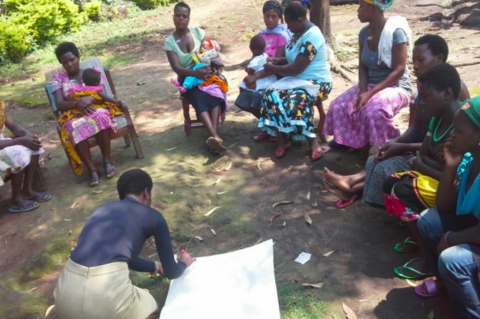
APC opted for a qualitative, participatory exploratory approach and adapted the Passages Social Norms Exploration toolkit (My social-network, Influence mapping, Vignettes, Pocket-chart, problem tree and 5-whys) and focus group discussions. All data were analyzed by thematic content analysis, and responses were quantified so that the information was conveyed not only in words but also visually using Power BI computer application. The exploration was purposeful and targeted the fertility hotspot districts. The key behaviors that were explored were teenage pregnancy, child marriage, negative attitude toward modern contraceptives, and resulting high fertility. These behaviors were explored across age groups in all target districts. It should be noted that high fertility, teenage pregnancy, child marriage, and early school dropout are greatly influenced by low rates of modern contraceptive use, hence the exploration also looked at factors behind these negative beliefs and thus we embedded Experience based-co design (EBCD) approach to identify community-driven solutions.
Results/Lessons Learned:
The main drivers of teenage pregnancy, child marriage and high fertility are not new and were clustered around religious influence, poor parenting, poor-quality FP services, limited access at the community level, limited sexual and reproductive health information, factors around schooling, peer influence, economic factors, crime, and political factors. Negative experiences by women using FP methods lead to entrenchment of negative social norms. Another key result of the exploration was the strong emergence of more negative social norms around modern FP methods, particularly around quality of services. Therefore, while negative norms around culture, religion, and tradition continue to hinder FP uptake and use, norms related to service quality have been established and are now deeply entrenched. These norms relate to the poor quality of FP services, but also long-standing myths and misinformation that also relate to the quality and mode of delivery of FP information at the community level.
Discussion/Implications for the Field:
Religion, culture, schooling, and male partners were identified as having potential to accelerate behavioral change, largely because of power, influence, respect, and trust. Family planning and pregnancy prevention messaging and services must be designed with these four areas in mind, with localized communication strategies to address what women have experienced. A social, multi-sectoral, community-based approach, with in a collaborative improvement science framework is more appropriate for ensuring that social and behavioral change interventions are successful because it is community-driven, allows for innovation, is data-driven, fosters accountability at all levels, is context-specific, and brings multiple stakeholders together to address common problems.
Abstract submitted by:
Ramadhan Kirunda - Research Consultant
Douglas Nsibambi - FHI 360
Approved abstract for the postponed 2020 SBCC Summit in Marrakech, Morocco. Provided by the International Steering Committee for the Summit. Image credit: Advancing Partners and Communities Project.