










































Wireless Know-How Helps Crisis Victims Reach Loved Ones
The New York Times
This New York Times article shares information about how long-distance wireless networks can be used in emergency situations, using the example of Mac Dearman who used such a system to assist evacuees after Hurricane Katrina. With the help of volunteers, donations, and support from the private sector, wireless systems were set up in a number of shelters for evacuees, enabling them to access information and connect with family members. Voice service was provided to the evacuees by using internet phone adapters and handsets that enabled calls to piggyback on the high-speed data connections. Mr. Dearman said that the servers on his farm that routed calls between the shelters and the internet handled 40,000 calls. Similar efforts were thrown together elsewhere in the hurricane-ravaged areas. Tropos Networks, which is based in Sunnyvale, California, and makes routers, worked with its customers, including wireless internet providers in Lafayette, Baton Rouge and New Orleans, to set up "mesh networks" that provided internet connections to Federal Emergency Management Agency shelters and others.
Wireless networks are an emerging technology that use unlicensed radio-wave bandwidth to send internet signals into rural towns and cities, where the connections are locally accessible, much like Wi-Fi hot spots. The networks typically use microwave dishes and routers to beam and distribute the information many miles in the air from an original internet connection. The advantage is that this system sidesteps many of the pitfalls that plague conventional phone systems during disasters. Other than the original internet connection, the technology does not rely on telephone wires run by phone companies; no roads have to be dug up and switching stations are not needed. Antennas that could not be placed near electrical outlets ran off solar panels that charged batteries during the day. Mesh networks are flexible, so if one antenna or dish is damaged, another one nearby picks up the slack. The Federal Communications Commission took note of these ad hoc networks, pointing out in recent proceedings that wireless internet providers helped restore communications in more than 400 places hit by Katrina.
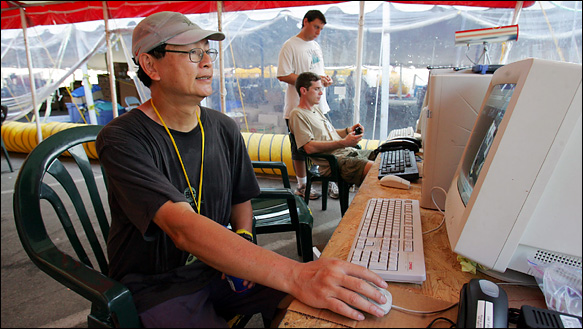
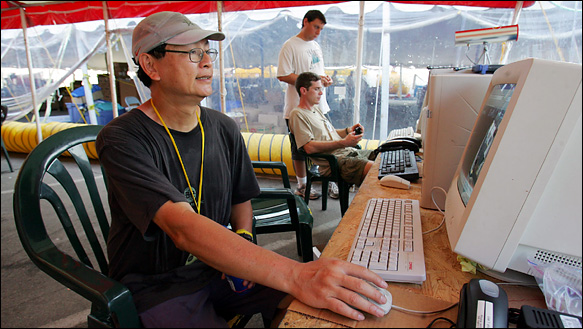
New York Times website, January 6 2006 and January 15 2010. Image credit: James Edward Bates for The New York Times.
- Log in to post comments