










































Knowing For Sure Without Knowing For Certain: How I Make Films
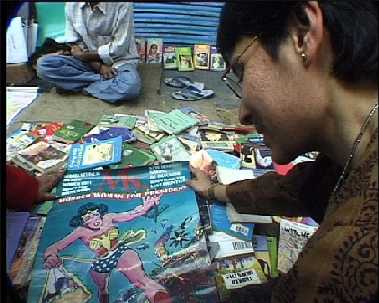
From the 4th Asian Women's Film festival of the International Association of Women in Radio and Television (IAWRT), this presentation by Paromita Vohra discusses how she makes films and how, despite her perceived marginalisation of documentaries, a large part of her goal in a film is "to make people think about filmmaking as a language and to talk about it."
Vohra describes feeling "like a pretender" when she first started working in documentary films at the age of 21 because she worked from "an instinctive relationship with the political impulse and ideas", rather than an intimate historical knowledge of the ongoing assumed ideas of progressive politics which were implicit rather than easily available in a general sense, which resulted in her "hectic political anxiety". She wondered if it was necessary for filmmakers to attach themselves to the movements about which they produced films in order to produce authentic political material. Her confusion about the responses of earlier documentary makers became "in itself a critique from which some new understanding was born for me about the kind of films I would eventually make." Her position evolved from the questions, "Do we make films that faithfully illustrate our political position on a particular matter? Or do we use our political position to arrive at an understanding of the subject and try somehow to bridge the gap between what we see when we look at something thanks to our political perspective?"
The filmmaker chose to find a way to include the idea that she might both agree and disagree with something by not choosing people for the film on the strength of their achievements, but how the conversation with them answered her personal questions about some of the ideas she chose to examine. She chose people "who inhabited a sort of middle space, or at least were willing to talk about the middle space."
Vohra recognises the repetitive nature of politicised film, which tries to convey ideas that are not in the "realm of common knowledge or a common value system", ideas that come from the margins, such as feminism in India. "In all of this, film as a medium gets engaged with for its amplificatory properties, more than its performative ones." She suggests choosing not to base a film on right or wrong, but on what matters and what doesn't, by taking a position and presenting it clearly. However, her style is not that of the exposé because: "... I do feel that if the instruments of justice really worked in our society then the exposé would serve a genuine purpose, which, following a natural path would lead to justice. But in the context of a rather cynical system and a disenchanted public, the language of the expose seems to reaffirm violence/injustice."
Thus, she chooses a style of conversation that will create a space she calls the "multiple window", a space without certitude that allows people "make more informed, more democratic decisions." In order to do this, Vohra includes ideas of which she is critical by using fictional ideas, for example, a fake article written in the style of pulp fiction as a commentary (the film was about the language of tabloid news).
The filmmaker describes her need to know what others are doing so as not to replicate, but work in "conversation" with them, to "learn from other films and complement them." Thus, she continues to create films where "some things are not quite said" so that the audience "will get it in their heads and will need to talk about it as a way of expressing what they’ve sensed" and in doing so, "the world can slowly embrace change."
Emails from Manohar Khushalani and Paromita Vohra to The Communication Initiative on April 22 2008 and September 20 2008, respectively; and Stage Buzz website and sawnet.com website, both accessed on September 8 2008.
- Log in to post comments