










































International Day of Climate Action
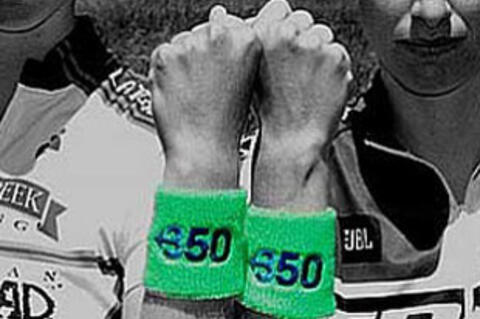
350.org is described as "an open-source campaign: it's your ideas, input, and energy that will make October 24 and this movement for change a success." To that end, information and communication technology (ICT) is the key conduit through which organisers will seek to: lift public awareness of the meaning of "350" and the need for political action, assemble a coalition of hundreds of organisations committed to this vision of a more sustainable world, connect individuals with others around the world who are building this movement, provide online resources and tools to facilitate October 24th event organising, and link these events with all others taking place at iconic locations around the world.
The symbolic actions being undertaken as part of the International Day of Climate Action integrate the numeral 350, thought to be powerful because it "translates into many languages - numerals are among the few things most people around the world recognize. More to the point, 350 tells us what we need to do." The timing of the October 24 mobilisation reflects the fact that the United Nations (UN) is working on a global climate treaty, which is expected to be completed in December of 2009 at a conference in Copenhagen, Denmark. But, worry 350 organisers, "the current plans for the treaty are much too weak to get us back to safety. This treaty needs to put a high enough price on carbon that we stop using so much. It also needs to ensure poor countries a fair chance to develop."
Visitors to the 350.org website may learn about the issues, get word of creative actions happening all over the globe, connect with others organising events, view photographs and other multimedia emerging from those events, spread the word to the media and politicians, etc. Amongst the tools offers here: "The Organizer's Toolbox", which includes: a log-in to manage one's own action page; "Action Management FAQs"; posters, print-outs, maps, and more to help spread the word in one's own community; "The 9-Step Plan"; and common inquiries about action organising.
This website is a communication and connection tool for actions - many very "low-tech" - that are happening "on the ground". For example, Bill McKibben, a founder of 350.org, spoke at the 2008 Episcopal Church's Diocesan Convention in the United States (US) about his hope that congregations will plan activities for that day to build awareness of the crisis of global climate change. He asked that churches ring their bells 350 times, and that they make sure every reporter in the area knows that this is planned. That gesture, which McKibben describes as easy, symbolic, and important, is amongst those one may read about on the online world map (which, as of September 28 2009, had over 2,500 actions registered in countries all around the world). Creative educational ideas for events involving groups of all sizes are included here.
Ideas for galvanising participation in the advocacy movement are also detailed on the 350.org website: "Often, the best ways to get people's attention are quirky, creative, and completely different - here are just a few fun ideas for building the buzz about 350 where you live." Suggestions include: putting up posters around town, heading to public celebrations with fliers about one's October 24th action in hand, asking "what is 350?" in sidewalk chalk to get people thinking, making one's own stencil (with tools offered on the 350.org website) and creating 350 materials, incorporating "350" into a public piece of art such as a mural, bringing 2 batches of cookies to a party (one baked at 350 degrees (looking delicious) and one baked at 450 degrees (burnt to a crisp) to illustrate what may happen to our planet), and "building the buzz online" - "post it to your Twitter feed, Digg it, update your Facebook status, or your personal blog".
Environment.
The initial catalyst for the 350.org campaign was James Hansen's landmark paper. "Target CO2: Where Should Humanity Aim?" In this paper, Dr. Hansen identifies 350 ppm as the upper boundary for CO2 concentrations - not CO2e. (CO2e is a calculation to account for other greenhouse gases - like methane - that contribute to climate change. It converts those gases to "equivalent carbon dioxide," and is often used by scientists and policy makers to offer a single metric that can be used for all greenhouse gases.) 350.org explains that Hansen focused on CO2 as the key greenhouse gas because it is the most prevalent in our atmosphere, has the longest life-cycle, and it is most integrated into industrial economies. But since 350.org formed, 350 supporters have started seeing 350 ppm in terms of CO2e. There are, according to 350.org, 2 reasons for this shift: "First, we've seen the impacts of climate change happening even more quickly than predicted....Second, as the 350 movement has grown more and more of the groups involved, particularly groups in developing countries, do work that focuses on greenhouse gases other than CO2." The key point, though, is that "Targets of 350 CO2 and 350 CO2e - both greenhouse gas concentrations significantly lower than current levels - have the same essential policy implications: we will STOP burning coal and other fossil fuel and we will START rolling out clean energy and other sustainable development strategies around the world."
"Ring Bells for 350.org's International Day of Climate Action on October 24", by Anne Clarke Brown, Mountain Echo, An Edition of Episcopal Life, Vol. 20, No. 10, October 2009; and 350.org website, accessed September 28 2009.

- Log in to post comments