










































Bridging the Divide

The Bridging the Divide website explains multifaceted social, ethnic, religious, political, and economic conflicts through a geography/history section. Featured here are local projects that are attempting to reduce the divide that is connected to each conflict. Here are some examples:
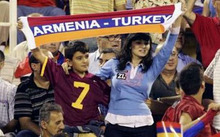
- The historical divide between the Eastern Ottoman Empire and historic Western Armenia is being addressed by the President Gul of Turkey and President Sargsyan of Armenia signing a set of protocols that would open the border between Turkey and Armenia. Bridging the Divide supports this process through two local organisations: the International Center for Human Development (ICHD), based in Yerevan, Armenia, and the Turkish-American Business Development Council (TABDC), based in Istanbul, Turkey. The organisations create a cadre of 2,000 Turkish and Armenian government, community, and business leaders who are advocating and supporting the principle of “open borders” between the two countries. This is being done through a series of town hall meetings and advocacy summits where participants are deliberating on in-depth issues related to a specific commission on protocols such as commercial trade, transportation, and cultural exchanges.
- Disabled Iraqis are learning to represent themselves through Bridging the Divide's partner, the Iraqi Association of Disability Organizations (IADO). Its strategy is to unite the voices of people with disabilities (PWDs) as they fight for their rights in the new Iraq and to create a new generation of PWD leaders with skills in advocacy, lobbying, and leadership.
- After civil war and foreign occupation, divisiveness in politics and religion remain unaddressed in the Beqaa Valley of Lebanon between clustered diverging populations.
- Alternative Society Organization (ASO)'s main goal is to support “free thought and expression” in “philosophy, literature, and other humanities,” and to “work on behalf of more humane, just, and imaginative society.” ASO supports the creation of “free and neutral spaces” where Lebanese youth from all religious, political, and sectarian affiliations can meet and discuss common issues and problems. This group of young leaders helped establish a non-governmental (NGO) called “Secular House” in Beirut, the Youth Culture Council in Zahle, and a network of students dedicated to addressing and speaking out against sectarian conflict within the Lebanese University in Zahle.
- A pilot programme intends to "increase the awareness of youth in the Beqaa valley on issues of peace, tolerance, and reconciliation through the use of established online web-portals and social media networks, such as Wordpress blogs, Facebook, and Twitter. Twelve ‘bridge-builders’ are being trained to manage the discussions and contents of the web-portals through thought provoking blogs, film, and photography. These young leaders will reach out to their communities and encourage them to participate in the dialogue by sharing thoughts, short films, essays, poetry on project sites to help the society as a whole move beyond the scars left by the Lebanese Civil War and fortify relations against future provocations of conflict."
- The Academy of Peace project has a three-month course covering citizenship, conflict resolution, and civic participation - with more than 60 young citizens enrolled in 3 different locations in north Beqaa. The participants learn to share their opinion on issues deeply related to their lives. The project concluded with an art exhibition and three plays that reflect participants' understanding of the project.
- Ola Lebanese Organization's ongoing four-event project Peace Through Painting, Planting, and Play integrates art, city beautification, and fun aimed to bring about an understanding of peace and its role in social conflict in the northern Beqaa Valley. Initial training for the project involves discussion of peace and courses in photography, computers, and social media. It ends with participants creating a website dedicated to the subject of peaceful activism, updating it with articles and essays. After a recent Ola-sponsored event commemorating the end of the Civil War, Youth Agency, an organisation of youth councils, was set up to introduce members from different sectarian backgrounds to one another and organise programmes in their neighbourhoods funded by Ola, in fields like education, the environment, and sports.
- Alternative Society Organization (ASO)'s main goal is to support “free thought and expression” in “philosophy, literature, and other humanities,” and to “work on behalf of more humane, just, and imaginative society.” ASO supports the creation of “free and neutral spaces” where Lebanese youth from all religious, political, and sectarian affiliations can meet and discuss common issues and problems. This group of young leaders helped establish a non-governmental (NGO) called “Secular House” in Beirut, the Youth Culture Council in Zahle, and a network of students dedicated to addressing and speaking out against sectarian conflict within the Lebanese University in Zahle.
Youth, Conflict
Bridging the Divide brings together practitioners in the field of relief and development to focus on issues of peace and justice in areas of conflict where local citizen groups are working to mitigate the possibility of increased violence. Through their website, they help citizens in the US engage directly with these groups.
In addition, Bridging the Divide provides continuous technical assistance to its partners, including supporting funding applications to international and bilateral donor organisations. In 2010, as part of the Armenia Turkey rapprochement project, Bridging the Divide held an advocacy summit in Istanbul, Turkey. Bridging the Divide and IJMA3, the Arab Union for Information Communication Technologies (ICT), formed an alliance to empower current and future partners working in the Middle East and North Africa (MENA) region through increased use of the new technologies in pursuit of their causes. In May 2010, Bridging the Divide held a regional conference in Zahle, Lebanon, with 7 partners: ICHD, ASUDA, IADO, Women Association of Kirkuk, ASO, Ola and LOST, concluding with the development of partnership agreements and the organisation of social media.
Alternative Society Organization (ASO), Asuda, International Center for Human Development (ICHD), Iraqi Association of Disability Organizations (IADO), Lebanese Organization for Studies and Training (LOST), Ola, Women Association of Kirkuk, funding from the United States Department of State Bureau of Population
Bridging the Divide website on July 19 2010. Image source: Bridging the Divide
- Log in to post comments