










































Bangladesh Knowledge Management Initiative: Strengthening Capacity for Social and Behavior Change Communication
This end of project report highlights the Bangladesh Knowledge Management Initiative (BKMI), a 3-year (2013-2016) United States Agency for International Development (USAID)-funded project under the global Health Communication Capacity Collaborative (HC3) project that supported the Government of Bangladesh, USAID implementing partners, and other stakeholders to develop strong, consistent, and effective social and behaviour change communication (SBCC) campaigns and interventions to improve the health and wellbeing of the people of Bangladesh. SBCC is the use of communication to influence individual and collective behaviours and social norms pertaining to health.
BKMI's overall capacity strengthening strategy was to introduce appropriate information and communication technology (ICT) knowledge management (KM) tools for SBCC, such as digital archives, eLearning, eToolkits, Android apps, websites, and communities of practice. In addition, BKMI used in-person trainings, hands-on mentoring, and participatory techniques to strengthen SBCC capacity. As is detailed at the links under Related Summaries, below, and in the report itself BKMI focused its capacity strengthening work at 3 levels:
- Improving the knowledge and skills of individuals who work in the 3 SBCC units of the Bangladesh Ministry of Health and Family Welfare (MoHFW): Bureau of Health Education (BHE) and the Institute of Public Health Nutrition (IPHN) in the Directorate General of Health Services (DGHS), and the Information, Education and Motivation (IEM) Unit of the Directorate General of Family Planning (DGFP) - one example: BKMI sponsored the attendance of 31 mid- to senior-level professionals from MoHFW in Bangladesh Center for Communication Program (BCCP)'s annual 15-day Advances in Strategic Health Communication workshop.
- Developing tools and establishing processes within the units to strengthen organisational capacity - one example: BKMI supported the 3 units to develop digital archives of their print and audio-visual (AV) SBCC materials. The digital archives are available to all online, which assists with institutional memory and reduces the likelihood of duplication.
- Working to optimise coordination of SBCC activities and integration of health, nutrition, and family planning topics at the system level - one example: In 2015, the MoHFW requested BKMI to provide technical assistance to draft the Comprehensive SBCC Strategy [PDF] and also to facilitate the process of collaboratively developing the strategy with input from a range of government and non-government stakeholders.
These levels reflect BKMI's alignment with the Socio-Ecological Model, which highlights factors that influence behaviours and behaviour change at the individual, family and peer networks, community, and social and structural levels. It recognises that individuals live in a dynamic context that can enable or discourage healthy behaviours.
The report goes into depth about activities carried out as part of the capacity strengthening work at each of the 3 levels, linking to resources created as part of BKMI and also sharing reflections on the process. For instance, coordination has been an important theme throughout BKMI's capacity strengthening work. Some of the keys to successful coordination have been regular communication and meetings, open sharing of information about plans and available resources, and consensus around which activities will benefit all parties. BKMI has supported and facilitated 2 forums for SBCC coordination: the BCC Working Group, which includes stakeholders from all sectors, and the HPN [Health, Population and Nutrition] SBCC Coordination Committee, which focuses on SBCC coordination within the MoHFW. Leadership of both groups is being transferred to the MoHFW. Also, since the beginning of the project, BKMI has emphasised government ownership and sustainability of digital resources (eToolkits, eLearning courses, and digital archives). As of September 2016: Both eToolkits are hosted on DGHS servers, and content is updated annually by a sub-group of the BCC Working Group; all 3 digital archives are hosted on MoHFW servers, and content is updated regularly by the 3 units; DGFP, DGHS, and Community-Based Health Care issued government orders to authorities in all 64 districts and 485 upazilas instructing them to use the BKMI eToolkit for Field Workers, eLearning courses, and digital archives; and links to eToolkits, eLearning courses, and digital archives are posted on DGHS, DGFP, MoHFW, and other websites.
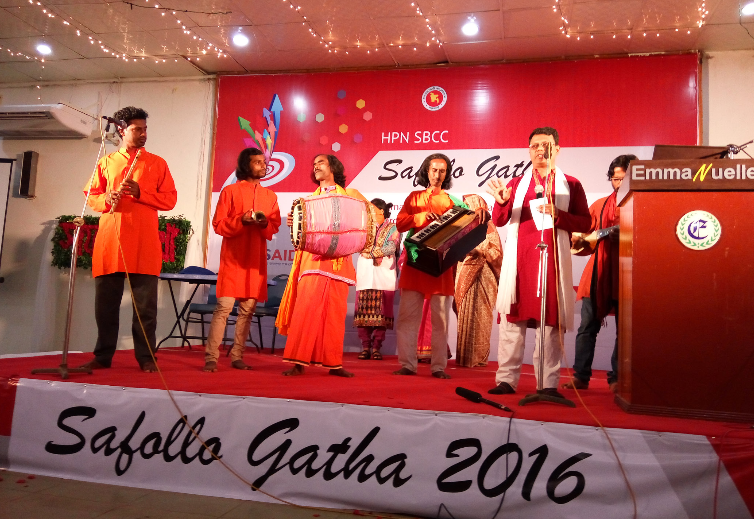
As detailed in the report, BKMI has drawn on various strategies to reach audiences. For instance, BKMI provided technical support to the 3 units to compile videos on health, family planning, and nutrition topics. Two sets of videos were created in 2015 and 2016. Each set contains more than 4 hours of drama serials, theme songs, television commercials, and other videos produced by MoHFW. The videos were distributed to government and non-governmental organisation (NGO) clinics, audio-visual (AV) vans and projects throughout Bangladesh in an effort to provide audiences with integrated health information in an entertaining format. Six hundred and sixty sets were distributed in 2015, and 960 sets were distributed in 2016. To cite another example, each year, the Best Practices Sub-group of the BCC Working Group identified best practices for health, family planning, and nutrition SBCC in Bangladesh to be presented during a festive and entertaining "share fair" known as "Safollo Gatha" (Success Stories). The first Safollo Gatha in March 2015 featured 6 presentations and drew 90 attendees; the second Safollo Gatha in March 2016 featured 12 presentations and drew 180 attendees.
In August 2016, BKMI conducted an outcome harvesting (OH) evaluation to assess and document the contributions of the 3-year project. In total, the OH team identified 65 outcomes linked to BKMI. The report provides select examples of outcomes that highlight progress made in key intervention areas of: (i) more strategic SBCC planning and implementation (e.g., IPHN integrated mobile technology in its SBCC programmes for the first time); and (ii) increased coordination for health, family planning, and nutrition SBCC (e.g., a sub-group of the BCC Working Group led the process of collecting, compiling, tagging, and vetting materials for the eToolkit for Field Workers).
The report offers several lessons learned from BKMI's experiences, including:
- "...A strong, dynamic leader within the MoHFW can produce significant results and impact, and can create a supportive environment for high-quality SBCC.
- Capacity strengthening requires strong relationships built on mutual trust and understanding. The MoHFW commitment to improved SBCC, together with BKMI's sustained presence and dedication to the MoHFW, resulted in a fruitful collaboration and noteworthy results...
- Capacity development is an ongoing process; as capacity is strengthened, the standard of quality is raised, which then requires further capacity development...
- To achieve sustainability in capacity strengthening, it must be a primary goal throughout the project, starting from the very beginning. Sustainability requires the ownership and commitment of the MoHFW.
- Working with the national-level government is a good investment, and allowed BKMI to have a larger-scale impact.
- Knowledge management is an important component of capacity strengthening for SBCC. Digital archives, a community of practice (the BCC Working Group), sharing of best practices (Safollo Gatha event), eToolkits and eLearning courses are all examples of KM techniques that contribute to stronger, more coordinated and effective SBCC in Bangladesh.
- Dramatic changes do not happen quickly. However, capacity strengthening is a cumulative effort, and a focus on the Capacity Strengthening Framework (see page 4) enabled a blended, multi-level approach to improving the quality of SBCC in Bangladesh.
- Embedded SBCC advisors...within the three units was a successful means to facilitate day-to-day mentoring for improved SBCC, and to develop strong, mutually-beneficial relationships between BKMI and the units...
- Capacity strengthening for the three units had to be tailored to meet the needs of each unit...
- ...Although BKMI led the development of digital resources for field workers with the intention of scaling them nationwide, scale-up is still in progress. Further scale-up will be possible with additional procurement of information technology (IT) devices, combined with plans and resources for training, supervision, support and monitoring of digital resources.
- BKMI has made digital resources available in different formats, so that they are more easily available to the largest number of people. For example, the eToolkit for Field Workers is available online, offline and as a mobile app. However, the disadvantage of this strategy is that it is more difficult to track, for example, how many people are using the offline eToolkit, or which resources are accessed most frequently on the mobile app."
The report concludes with a number of recommendations for continuing the process of improving the quality of SBCC in Bangladesh. To cite only a few examples:
- Promote a holistic understanding of SBCC that is theory-based and that prioritises a two-way dialogue with audiences. Focus on changing behaviours, rather than disseminating messages or raising awareness.
- To facilitate coordination for SBCC in Bangladesh, a thorough landscaping of current SBCC activities is needed. Furthermore, all organisations involved in SBCC should participate in digital information sharing platforms, and must actively and regularly update their materials and activities.
- Identify a clear research agenda to strengthen SBCC in Bangladesh. Some topics could include: undertaking in-depth audience research for particular audience segments; understanding how people use mobile phones; and demonstrating how SBCC contributes to increased healthy behavior adoption that lead to improved health outcomes in Bangladesh.
- Prioritise SBCC programmes that are sensitive to gender considerations. SBCC should segment audiences by gender when appropriate, as well as create opportunities for individuals and communities to actively challenge prevailing gender norms.
HC3 website, May 5 2017; and email from Rebecca Arnold to The Communication Initiative on June 6 2017.
- Log in to post comments