










































CEPEHRG and Maritime, Ghana: Engaging New Partners and New Technologies to Prevent HIV among Men Who Have Sex with Men

Specific elements of the project included:
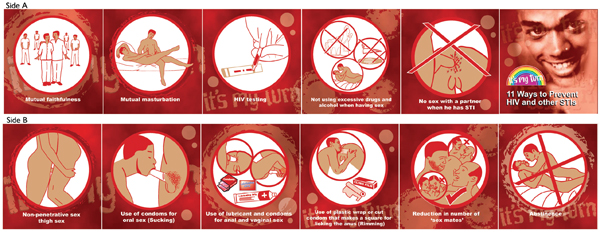
- Prevention outreach: Building on its research findings on MSM in Ghana, and in consultation with USAID and its government and non-governmental organisation (NGO) partners, SHARP worked with the Ghana Sustainable Change Project (GSCP) - another USAID-funded project implemented by AED - to develop a basic package of BCC tools and interventions for MSM, including a participatory training curriculum for peer educators. The package contained BCC materials that could be distributed to participants in prevention outreach sessions. The materials included pocket-sized brochures listing MSM-friendly clinics and drop-in centres or illustrating HIV and sexually transmitted infection (STI) prevention behaviours. One of the brochures is purposefully graphic in its visual representation of behaviours that can reduce transmission risk of HIV and other STIs (see image above). The direct nature of these materials was designed to reinforce the lessons taught during peer outreach.
Peer educator-led outreach sessions for MSM promoted risk reduction behaviours, offered referrals to testing and clinical services, sold condoms and lubricant, and provided counselling by trained health care workers.
The programme also worked with its implementing partners on outreach events that included large community parties and small gatherings at private homes and at hot spots such as bars and clubs that attract MSM clientele. Integrating HIV prevention messages into social activities, these events were designed to raise awareness, within a broader peer group, of the value of open communication in MSM relationships and the importance of condom use and other prevention behaviours, such as partner reduction.
- HIV and STI services: Clinical services for MSM were also supported at government-run clinics as well as at the four drop-in centres run by SHARP's NGO partners. Services included STI diagnosis and treatment, HIV counselling and testing, post-test counselling and support, antiretroviral therapy (ART), and referrals to other services if necessary.
- Health care worker training: SHARP developed a most-at-risk-population (MARP)-friendly curriculum and trained providers to increase their understanding of MARP-related health issues and expand their capacity to provide responsive care in a supportive and non-stigmatising environment.
- Support groups: SHARP encouraged CEPEHRG and Maritime to set up support groups for MSM living with HIV.
- "Text Me! flash Me!" Helpline: In Ghana, if people have charged phones and a minimal amount of call credit, they can receive calls and "flash" others (call and hang up before the recipient of the call picks up). This costs nothing and signals that the caller at the number shown on the phone's screen wants to be contacted. Branded as part of the "It's My Turn" campaign, the Helpline was staffed by employees of implementing partners and by HIV counsellors from government clinics. To prepare them for this new role, SHARP worked with a number of stakeholders to develop a training curriculum and provided ongoing support to the counsellors. The Helpline was designed to function during a set period of time each day, and callers would "flash" the counsellor on call, who could then phone back directly to answer questions, provide support, or share information about where to find services. Users were also able to send text inquiries that generated automated text responses on a variety of basic topics relevant to MSM health and well-being. In turn, the callers' cell numbers were recorded, with care taken to maintain confidentiality and protect their identities. Subsequently, these contacts were sent regular text message reminders about condom use, the need for testing, and the availability of the Helpline to answer questions or provide directions to clinics.
HIV/AIDS.
MSM are, on average, over nine times more vulnerable to infection than the general population. And yet, according to James Robertson, author of the case study "CEPEHRG and Maritime, Ghana: Engaging New Partners and New Technologies to Prevent HIV among Men Who Have Sex with Men", MSM have been neglected in HIV programming in sub-Saharan Africa - frequently ignored in national strategies and hidden in the face of intolerance, stigmatisation, and punitive laws. The media and most prevention programming in the region consistently describe HIV vulnerability in terms of heterosexual risk, and many African MSM do not realise that they too are vulnerable. (Robertson points out that, in discussions with MSM in Ghana, many said that before they received MSM-specific education, they had thought condom use was only necessary during vaginal sex.)
That said, Ghana, which, like its neighbouring states, condemns homosexuality, is distinguished from most countries in sub-Saharan Africa by the level of activity addressing HIV among MSM. Although the Ghanaian government has not publicly embraced these efforts, officials have also not prevented the development of these interventions, despite the legal prohibition of homosexual behaviour.
CEPEHRG, Maritime, USAID, AED/SHARP.
CEPEHRG and Maritime, Ghana: Engaging New Partners and New Technologies to Prevent HIV among Men Who Have Sex with Men, by James Robertson, January 2010.
Image courtesy of AED/SHARP and AED/Ghana Sustainable Change Project (GSCP)
- Log in to post comments