










































Coalitions for Change: Collective Action, Better Media Ecosystems
"Media freedom is often best defended and advanced by organisations working together to effect change."
This learning brief is based on the findings of an online workshop that was organised by International Media Support (IMS) in early September 2021. The learning brief focuses on the issue of coalition-building in the field of media development and provides an overview of strategies, lessons learned, and key considerations in an effort to develop "enhanced strong and inclusive coalitions that defend and support the space for media freedom and viability in different contexts". The brief draws on the experiences of the individuals and organisations who participated in the workshop and on six case studies that illustrate the challenges inherent in coalition-building and the key factors for success.
The brief was developed as part of the Protecting Independent Media for Effective Development (PRIMED) programme, a three-year initiative to support the provision of public interest media in Bangladesh, Ethiopia, and Sierra Leone. The workshop was held to support the work of PRIMED to strengthen collective advocacy initiatives - "coalitions" - in the three countries. Although intended primarily for stakeholders involved in the PRIMED programme, the lessons and strategies outlined in the brief are also meant to benefit the wider media development community.
As outlined in the brief, PRIMED defines a coalition as a "temporary alliance of different actors with a variety of interests and affiliations looking to achieve common goals through collective action and advocacy....Whether they coalesce around a specific issue or provide short-term technical assistance, media coalitions are generally aimed at fostering an enabling environment for independent journalism and freedom of expression. Their actual composition will depend largely on their raison d'être but most bring together media houses, journalists' unions, publishers' associations and civil society organisations. They are often supported by the donor community and benefit from the input of international media development agencies. In some cases, they are initiated by external actors."
The brief outlines the strengths of coalitions, which lie mainly in their ability to contribute to better informed, coordinated, and magnified sectoral support that will support media freedom in a country. Experience has, for example, shown that coalitions have significant potential to frustrate attempts to place restrictions on a media sector and are instrumental in building the confidence of practitioners. "Crucially, coalitions play a vital role in securing consensus and driving collective action within the media community, helping diverse stakeholders to devise and execute a common strategy, and define joint success criteria".
The brief unpacks the key findings of the workshop in relation to: the architecture and leadership of coalitions; the evolution or growth of a coalition; support from the international community; methods, tools, and techniques for building a coalition; ensuring sustainability; and common challenges. In dealing with each of the above themes, the brief highlights key considerations when looking to support coalition-building.
Findings show that the architecture of coalitions will vary significantly and will depend on the target geography and the themes being addressed. However, "it is widely agreed that a focus on inclusivity gives coalitions greater credibility and coherence. It ensures that diverse interests are represented and that, ultimately, the results of a coalition's work enjoy a high level of ownership." Key considerations around assembling a coalition include: ensuring diversity, building credibility, maximising convening power, and including people in positions of influence.
Case studies and personal experiences explored during the PRIMED workshop also suggest that coalitions can be led in a variety of different ways. "In some cases, a single organisation (sometimes an international development actor) takes the initiative and is responsible for assigning roles or setting the agenda. In others, individual members can take leadership positions for different work streams or thematic priorities. Ultimately, however, a coalition achieves momentum when all members make a proactive contribution because they have a stake in the issues being addressed. This collective approach is underpinned by shared accountability and a commitment to embracing lessons learned."
In terms of evolution, the brief notes that there is no predetermined developmental arc that a coalition should follow. Coalition leaders may prefer to start small and build their efforts gradually, basing strategic decisions on learning and experience. In other cases, the complexity of the target issues and the breadth of its vision will determine the pace and scale of a coalition's evolution.
The role of the international community in coalition-building is also an important consideration. Participants in the workshop suggested that the preferred model for support was for media development agencies to initiate and nurture an action and then for coalition members to take ownership and set the agenda. Media agencies can also play an important role in training and technical assistance to support advocacy efforts, facilitate knowledge sharing, offer access to external experience, and improve donor coordination to avoid duplication of effort and to explore synergies.
The brief highlights an array of tools and techniques for building the capacity of coalition members, and for facilitating a dialogue between key stakeholders and advocating for positive change. They include: research and monitoring, stakeholder consultations with those directly affected by the action, direct advocacy by bringing together stakeholders from different camps to discuss challenges and explore solutions, exchange of experiences, media coverage of the issue, and public engagement. The brief also offers insights into common areas for up-skilling.
The brief notes that the sustainability of coalitions is mainly linked to a coalition's relevance and to the shifting agendas of stakeholders. "Theme-specific coalitions may struggle to remain relevant once they have achieved their primary goals. However, a coalition which has the resources and mandate to address the shortcomings of a media ecosystem on multiple levels is more likely to be seen as an enabling mechanism for members to address the wider challenges they face." Some of the barriers to sustainability identified include donor dependence, co-opting of civil society leaders by government, too great a reliance on traditional engagement and communication methods, and waning of interest among key stakeholders.
Common challenges and key attributes of a successful coalition are also discussed. Challenges include building trust with government stakeholders, managing competing agendas, maintaining momentum, and contending with limited knowledge and experience with coalition-building. Attributes for success are, for example, a deep understanding of the context, mutual trust, a shared vision, and local ownership.
The brief shares six examples of coalitions in action. Each case study outlines the objectives of the coalition, activities, outcomes, key outputs or achievements, and lessons learned. They are:
Case study 1: Coalition Building for Press Freedom in Somalia
Case study 2: Media Alliance of Zimbabwe
Case study 3: Pakistan Journalists' Safety Coalition
Case study 4: Media Freedom in Zambia
Case study 5: Declaration on Media Freedom in The Arab World
Case study 6: Media Advocacy Coalition, Republic of Georgia
The document ends with a list of coalitions-related knowledge compiled for PRIMED by The Communication Initiative.
Following the Coalitions for Change workshop, the author of this learning brief, Michael Randall, also spoke with five of the workshop's key informants about their experiences of coalition-building and the lessons they have learned. Two of the interviews have been made available as edited transcripts; the other three are available as audio recordings). Click here [PDF] to read the transcripts, which include interviews with Jane Chirwa, Project Manager, MISA-Zambia, and Dr. Haron Mwangi, media academic and co-author of "Mapping Coalitions" (see Related Summaries, below). Michael Randall's blog on the workshop ("The Ultimate Stress Test for International Support") is also available below.
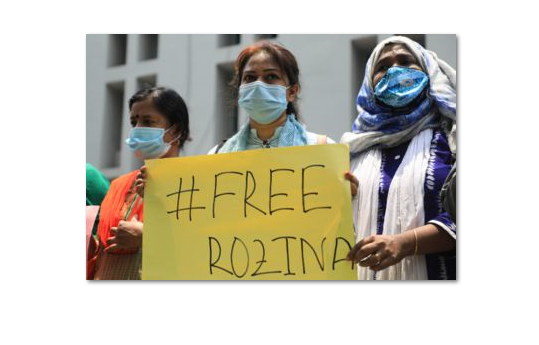
Emails from David Lush to The Communication Initiative on December 1 2021, December 13 2021, and January 21 2022. Image caption/credit: Protesters in Bangladesh demand the release of journalist Rozina Islam at National Press Club in Dhaka in May 2021. Photo by Md Manik/SOPA Images/LightRocket via Getty Images
- Log in to post comments