










































COVID-19 Emergency Response: Risk Communication and Community Engagement in the Americas
"[T]he COVID-19 pandemic has impacted operations and required a different approach to communication with communities."
Since the outbreak of COVID-19 in the Americas in March 2020, United Nations High Commissioner for Refugees (UNHCR) and its partners, in coordination with key actors, have been developing alternative means of communicating with communities, engaging and mobilising them. This paper compiles promising practices on risk communication and community engagement (RCCE) in the Americas during the pandemic.
Broadly speaking, rapidly changing dynamics in the field due to the outbreak mean that UNHCR has had to adapt its services and support to refugees, asylum seekers, internally displaced populations (IDPs), and stateless people and those who host them in the region. To that end, UNHCR has enhanced and enlarged its communication channels to ensure the continued provision, in various formats and languages, of health and protection information to the populations it serves. When approaching communities, UNHCR uses what it characterises as creative and flexible mechanisms, aiming at open and sustainable two-way communication. The organisation explains that this strategy is also critical to ensure timely analysis of risks, needs, and gaps of the people most in need, and to ensure coordination with national authorities and humanitarian actors.
Reaching out to the communities has happened through:
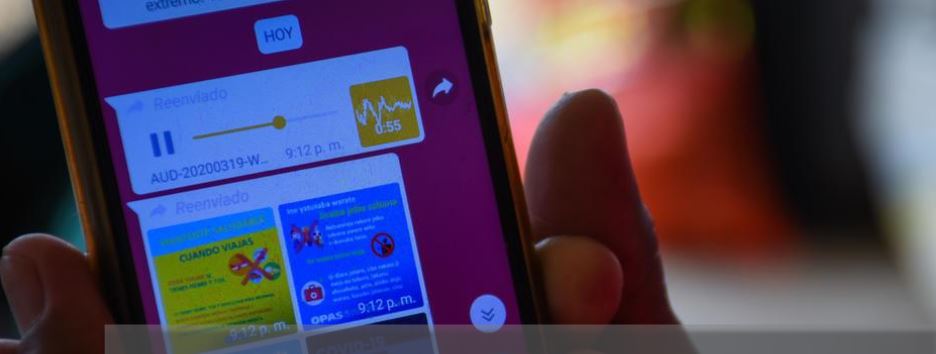
- Social media platforms - For example, messages from World Health Organization (WHO)/Pan American Health Organization (PAHO) have been disseminated through WhatsApp, Facebook, Twitter, and Instagram in all countries. Offered in different languages and formats, these messages have focused on issues such as preventive measures and rights of persons living with HIV, sexual and gender-based violence (SGBV) prevention and response, information on migratory procedures, guidance on how to identify fake news, among many other topics. Several examples are provided, such as YouTube videos to raise awareness on COVID-19 prevention measures that were created by Venezuelan influencers with the support of UNHCR in Ecuador. (See below for one video.)
- Posters - For example, to help address xenophobia, UNHCR Chile worked with the United Nations Population Fund (UNFPA), United Nations Educational, Scientific and Cultural Organization (UNESCO), and the non-governmental organisation (NGO) Chilean Network of Migrant Journalists to create a brochure with recommendations on how to prevent stigmatisation of refugees and migrants in journalism and reporting in the context of the pandemic.
- Community radio - For example, WHO/PAHO messages and other preventive messages adapted to the needs of different groups, such as indigenous communities (e.g., the Yukpa, Wayuu, Jivi, Wotuja, Eñepa, and Warao), are shared by UNHCR and partners through community radio stations in Venezuela, Colombia, and Brazil.
- Multimedia - Different audio and video materials with key messages are disseminated across the Americas. For example, community structures and youth groups in Zulia, Venezuela and in Honduras produced and disseminated videos and songs with messages on COVID-19 prevention. And UNHCR, in alliance with the Mexican Refugee Commission, the Mexican Institute of Cinematography, the United Nations Children's Fund (UNICEF), and other collaborators, put together a video library with COVID-19-related content that is accessible to 24 shelters.
- Call centres and helplines - UNHCR and partners in the Americas enhanced helplines in most of the countries; information on new numbers is disseminated through social media and other channels.
- SMS (text messaging) - For example, in Guatemala and in Trinidad and Tobago, prevention messages are shared through SMS with refugees and migrants.
- UNHCR HELP website - It provides information, for example, on how to request asylum in Canada during the COVID-19 pandemic.
- Information sessions - In Brazil and El Salvador, interagency actions on disseminating information and health practices are taking place in temporary shelters, spontaneous settlements, and some support spaces (e.g., screening centres).
- Outreach volunteers and community groups - In different countries of the Americas, UNHCR is working with community committees, community leaders, associations, and community groups to ensure two-way communication, understand their needs, and produce COVID-related information material. (Various examples are provided). UNHCR and partners are also mobilising communities to support those at heightened risk through existing community networks and online platforms (e.g., a remote simplified protection monitoring tool) and without compromising their own security.
Other aspects of UNHCR's role in the COVID-19 context are explored in the paper. For instance, UNHCR's Bureau for the Americas provides guidance through global and regional tools adapted to the impact caused by the pandemic. In addition, through interagency coordination, UNHCR works to ensure that a harmonised and coherent response is in place during the crisis. Examples of coordinated efforts of different structures in the region are provided, such as the multi-faceted work of the Regional Interagency Coordination Platform for Refugees and Migrants from Venezuela (R4V). The RedLAC communications group continues coordinating efforts on messages and information regarding COVID-19, providing a repository of content and material to be used by all members.
UNHCR actively seeks and encourages feedback from the communities through various communication channels. Engagement with persons of concern happens through community networks, leaders, trusted interlocutors, community groups, and outreach volunteers and takes place on a regular basis via WhatsApp groups, virtual focus group discussions, protection monitoring, communication trees, and online or remote services. Feedback mechanisms are monitored, and feedback is collected via email, private messaging, hotlines, online platforms, focus group discussions, and individual interviews when possible.
There are challenges to UNHCR's RCCE work in the Americas during COVID-19. In a context of heightened risks and needs, opportunities and modalities of communication and outreach with the population of concern are limited as a result of the impact of the pandemic. For example, considering general restrictions on movement imposed in most countries, limitations to internet access pose an obstacle to effective two-way communication with communities of concern. Furthermore, increased xenophobia and discrimination against refugees, IDPs, and others of concern with the spread of the disease in the COVID-19 context is driving them to maintain a low profile, making it harder for humanitarian actors to reach out to those at heightened risk.
ReliefWeb, June 15 2020 - accessed on June 19 2020.
- Log in to post comments