










































Exploring Factors that Influence Vaccination Uptake for Children with Refugee Backgrounds: An Interpretive Description Study of Primary Healthcare Providers' Perspectives
"This study highlighted provider-patient relationships as a key contributor to former refugees' long-term engagement with the practice and increased likelihood of vaccination uptake."
Complex, interrelated factors influence immunisation service provision for refugee children. In Aotearoa, New Zealand (NZ), reported age-appropriate vaccination rates are suboptimal among children with refugee backgrounds. This research explores insights and challenges faced by health professionals delivering immunisation services to refugees. The aim of this study was to explore providers' perceptions about factors that influence complete and timely immunisations for refugee children upon resettlement in NZ and identify strategies to improve immunisation uptake.
As part of the qualitative interpretive description (ID) study, semi-structured interviews were conducted between June 2019 and July 2020 with healthcare providers (nurses and doctors) (N = 14) across 7 resettlement locations in NZ. Consistent with ID methodology, an inductive approach was used in the data analysis.
Five themes were derived from the data that demonstrate the interrelated factors that influence vaccination uptake across the refugee caregiver, health provider, and system levels. Key findings include:
- Resettlement priorities and challenges: Providers discussed how caregivers' competing resettlement priorities and challenges early in the resettlement phase influenced their knowledge and access of vaccines and health services in NZ. Participants perceived that access to preventative healthcare services became easier as former refugees became more acquainted and engaged with NZ society. For this reason, many participants stated they actively encouraged community engagement and interacting with others in the wider population.
- Knowledge as a driver for change: Providers' knowledge of refugee caregivers' concerns was seen as a driver for positive change in forming therapeutic relationships with, and delivering health services to, former refugees. To support immunisation delivery, participants highlighted the importance of knowledge: of refugee healthcare needs and entitlements; of culture, language, and refugee experiences; of services that support former refugees; and of how to create immunisation catch-up schedules for former refugee children. Participants expressed a strong desire to increase their expertise and confidence in managing the immunisation process with former refugees.
- Working within the system: There are multiple factors within the healthcare system and wider socio-political system that can amplify or alleviate the challenges faced by providers and the social determinants of health experienced by refugee families, such as resourcing, resettlement policies, system inefficiencies, and missed opportunities. For example, the standard consultation time for an immunisation event with former refugee children was perceived to be too short due to the complex health needs, large family sizes, and need for an interpreter.
- To understand and to be understood: Communication challenges were recognised as one of the most significant barriers to providing care for former refugees, affecting all aspects of engagement and immunisation delivery - from booking appointments to the immunisation event and aftercare. These challenges, alongside a lack of multilingual information resources, led to practices developing their own communication strategies to convey immunisation information to refugee caregivers. These strategies included the use of Google translate, interspersed with visual imagery and body language.
- The service needs to change: Strategies were suggested to overcome identified barriers and included providing culturally and linguistically appropriate resources, developing education campaigns, reducing access barriers (e.g., after-hours clinics), and improving system efficiencies.
Going forward, the researchers suggest that opportunities to co-design solutions with the refugee community, healthcare providers, and other key stakeholders "will ensure implemented strategies are responsive to stakeholders' needs. A NZ based integrative review...found that existing research on refugee health has primarily been informed by Western research paradigms and was biased towards the knowledge perception of healthcare providers. Knowledge acquired within this research paradigm is then translated into recommendations that may, or may not, resonate with the refugee population. These findings further strengthen recommendations for culturally informed research that explores the refugee perspectives of accessing and receiving immunisations and developing solutions in partnership."
In conclusion: "There are multiple factors within the healthcare system and wider socio-political system that can amplify or alleviate the challenges faced by providers and the social determinants of health experienced by refugee families. Improving access and service provision will require multi-level strategies that address this broad spectrum of issues....Building a more culturally responsive immunisation service will require input and collaboration from the refugee community, including non-quota refugees, as well as health providers and key stakeholders."
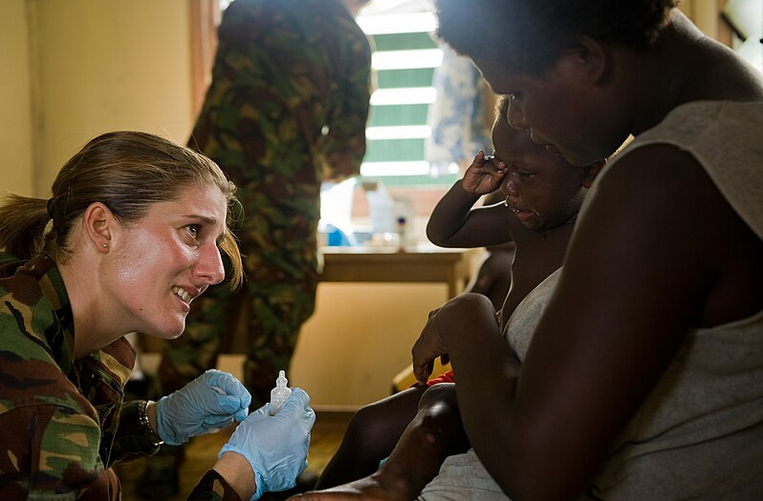
Vaccine 41 (2023) 6690-99. https://doi.org/10.1016/j.vaccine.2023.09.055. Image credit: New Zealand Defence Force from Wellington, New Zealand, via Flickr (CC BY 2.0 Deed)
- Log in to post comments