










































Formative Evaluation of Communication Processes Used for the National Measles Rubella Vaccination Campaign for Inclusion in Routine Immunization
"[T]he result of all communications and operations working in tandem with each other helped in achieving the desired coverage of more than 95 per cent in each state."
In June 2019, the Government of India concluded a two-year long measles-rubella (MR) campaign that sought to immunise 410 million children between nine months and fifteen years of age across the country. The United Nations Children's Fund (UNICEF), as one of the primary campaign implementation partners, commissioned the Centre for Media Studies (CMS) to conduct an evaluation of the campaign, with the goal of determining how and to what extent the communication processes for the MR campaign were relevant, effective, efficient, and sustainable in terms of their capacity to be introduced into the routine immunisation programme.
As the report outlines, the MR campaign was carried out in a phased manner across the country. The first phase of the campaign was launched in February 2017 in Tamil Nadu, Karnataka, Goa, Lakshadweep, and Puducherry. However, factors such as negative messages on social media regarding the vaccine, inaccurate reports of adverse events following immunisation (AEFIs), sub-optimal participation of private schools, varied involvement of paediatric associations, and limited inter-ministerial coordination impeded uptake of the MR vaccine. These issues required re-strategising to place adequate emphasis on communication-related strategies and involvement of stakeholders at various levels.
The second phase of the MR campaign integrated communications as an essential element. It featured significant coordination among various government departments, Panchayati Raj Institutions, development partners, civil society organisations and community-based organisations, associations of private medical professionals, and faith-based leaders. Furthermore, inclusion of vulnerable and marginalised communities was ensured at every stage of this phase of the campaign. The strategy also called for steady media engagement to ensure proper reporting of events and progress of the campaign.
States referred to national guidelines to design their local campaign activities, while also formulating unique strategies to address local challenges and nuances. Each state organised systematic training for all relevant officials in the district, for community health workers, and for key stakeholders and partners. The communication strategies addressed schoolteachers, local religious and political leaders, celebrities, children, and parents to promote vaccine confidence among the public. While Bollywood superstar Amitabh Bachchan, who was earlier the face of the polio campaign, was the primary celebrity figure used at the national level, states reported having local television and regional movie celebrities promoting the campaign.
Influential doctors from the communities also played a key role. Their video endorsements, public engagements, and presence at the vaccination centres were designed to instill faith in people about the quality of the programme. The Indian Academy of Paediatrics ensured transparent and effective reporting of AEFI cases. They also helped in clarifying rumours. The Indian Medical Association also worked to influence caregivers, with local paediatricians and practitioners building community trust and promoting vaccine acceptance.
To cite a few specific examples of activities: In the eastern state of Odisha, separate plans were devised for coastal and tribal areas. While mass media strategies were more intensively applied in coastal regions, strategies for tribal areas focused on interpersonal communication. Odisha collaborated with the state cultural department, and UNICEF worked closely with them in areas where mass media was not accessible. In Uttar Pradesh, the migratory population was high along the state borders and in the industrial towns. During the outreach activities, border-based booths were set up at bus stands and railways stations. In hamlets and tribal areas, mid-media activities such as street plays and folk shows were conducted.
The evaluation of the MR campaign was conducted across five states, which were purposively chosen based on their involvement in various phases of the MR campaign and the context they offered. They included: Assam, Odisha, Gujarat, Maharashtra, and Uttar Pradesh. The evaluation adopted qualitative data collection methods: a desk review of reports and documents pertaining to the MR campaign, alongside primary data collection through 33 semi-structured key informant interviews (KIIs) with stakeholders and partners who actively participated in this campaign, 159 in-depth interviews (IDIs) with frontline health workers, and 80 focus group discussions (FGDs) with parents and caregivers.
The evaluation found six critical processes that included elements of communication that explained the campaign's success in vaccinating 95% of the children it sought to reach. These processes were:
- Identification and collaboration with key stakeholders - from the state and district to the subdistrict and community levels;
- Training of frontline workers that focused on micro-planning, AEFI management, social mobilisation, and interpersonal communication (IPC) and that sought to empower them to address vaccine hesitancy by clarifying doubts and addressing myths and misconceptions;
- Monitoring of AEFIs and media advocacy;
- Management of social media;
- Maximising the reach through mass media and materials focusing on information, education, and communication (IEC); and
- Social mobilisation.
All six of these processes were analysed under the four criteria of relevance, effectiveness, efficiency, and sustainability; findings are presented in the report. For example, IPC undertaken by frontline workers to address the concerns of caregivers and encourage uptake of the vaccine was reported to be the most effective means of disseminating messages. Caregivers in the study states could recall the messages received on issues such as side effects, how to manage them, and the purpose of the vaccine. Caregivers recalled seeing posters and banners, but most of them recalled receiving the information from frontline workers or from school authorities. Despite simple messaging (e.g., in the IEC materials) and the organisation of what were intended to be engaging activities with the communities, caregivers could not articulate completely the benefits of MR vaccine and confused the rash of measles with chickenpox.
Among the suggestions going forward would be to adopt strategies to reach out to fathers and other decision-making members of the family. The evaluation found that campaign plans and actions were not gender sensitive in their approach, and activities were aimed at caregivers in general. Thus, most of the activities were attended by mothers; only a few activities were directed at men in an ad-hoc manner in places where uptake was reported to be very low. The plans at every level should include programmes directed towards men that specify ways to reach them and that feature specific content explaining their role in children's immunisation. Other recommendations include:
- Sustaining media engagement requires moving beyond sensitising journalists and focusing on editors and sub-editors as well, as they are the final decision-makers about the content of the news.
- The plan for dissemination of messages through social media needs to be recalibrated, considering that only one group of caregivers in FGDs conducted in all five states said they could recall receiving any such positive message on social media. The planning should be proactive so as to avoid reactive responses to negative messages. Short videos addressing the rumours could be made for frontline workers to show or disseminate through WhatsApp among their communities. Leveraging the voices of local celebrities, political leaders, or faith leaders to whom the community can relate can make the messages in these videos more relevant and motivating.
- Inter-state communication needs to be encouraged to share innovative and successful practices.
Some of the practices developed based on learnings from the MR campaign, such as partnering within departments and with CSOs and CBOs, following a stringent AEFI monitoring and redressal protocol, and disseminating videos by public figures promoting and endorsing certain messages, have already been adopted and are being utilised in the routine immunisation programme, Intensified Mission Indradhanush campaign, and COVID-19 communication-related activities.
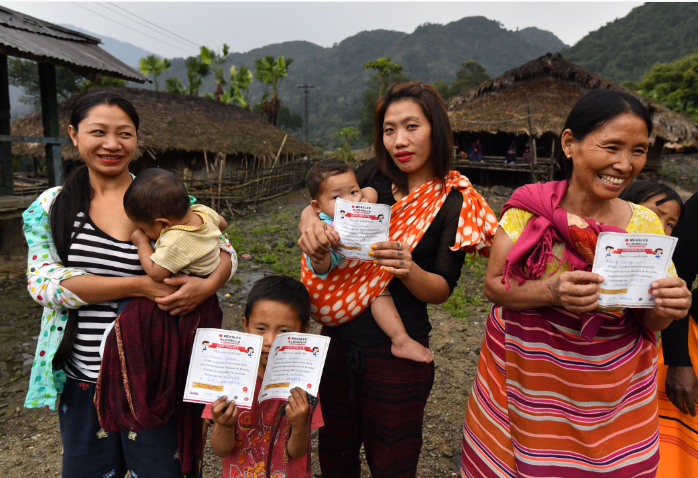
"Research: Train Frontline Workers, Amplify Voices and Partnerships to Immunize Every Child", by Sumita Thapar, UNICEF India - sent from Sumita Thapar to The Communication Initiative on August 16 2021; and email from Sumita Thapar to The Communication Initiative on August 20 2021. Image caption/credit: Villagers with their children for MR vaccination sessions at Pongging village in Upper Siang district in India's northeastern state of Arunachal Pradesh, February 24 2018. © UNICEF/UN0200085/Boro
- Log in to post comments