










































Gender and Resilience: From Theory to Practice
Building Resilience and Adaptation to Climate Extremes and Disasters (BRACED)
"One year into the implementation of the Building Resilience and Adaptation to Climate Extremes and Disasters (BRACED) programme, this working paper reflects on progress in linking gender equality and resilience within development projects."
This paper presents a synthesis of four BRACED case studies (linked below) from Mercy Corps (Uganda), ActionAid(Myanmar), Concern (Sudan/Chad) and Christian Aid and King’s College London (Burkina Faso) in order to document:
- "how gender inequalities manifest themselves in all four contexts affected by climate change;
- how gender is conceptualised in project theories of change (ToCs);
- the operationalisation of objectives to tackle gender inequalities;
- internal and external obstacles to the implementation of gender-sensitive activities; and drivers that help NGOs transform gender relations and build resilience."
In the discussion of manifestations of gender inequalities, Box 3 lists the following tools to carry out gender analyses: a Vulnerability and Capacity Assessment (VCA) from Mercy Corps; Concern’s Gender Equitable Attitudes Scales and key informant interviews; Christian Aid's BRACED participatory assessments (BRAPAs); and ActionAid's "village books", "a bottom-up approach to community development whereby fellows (youth leaders) are trained to mobilise local communities to collect data, analyse their situation and plan for change." Findings show, for example, increased women's workload and women head-of-household and increased women’s mortality; more girls dropping out of school than boys; increased domestic violence, child marriage, courtship rape, and female genital mutilation/cutting; and a "masculinity crisis" linked to the loss of livelihoods.
Project designs aimed "to address the gender dimension of resilience, as well as the underlying assumptions of how social dynamics, power relations, access to resources and capacities interact and shape people's responses to climate change and disasters" as diagrammed on pages 25-27.
Section 3, page 33 summarises gender-focused project activities. Examples include:
- For microfinance village saving and loans associations (VSLAs) for women and ethnic minorities in Myanmar, developing a gender checklist for guidance and training of women community volunteers.
- For markets and farm product development for women farmers in Uganda and Kenya, developing a gender strategy for building resilience, identifying gender champions, conducting a radio-based behaviour change campaign, establishing safe spaces by gender for adolescents "to improve understanding of and break down gender stereotypes, Facilitating monthly open forum discussions between local authorities, women’s representatives and councillors, to strengthen access to information."
- In Burkina Faso, involving women in development of community resilience plans, improving women’s access to land and climate information.
- In Chad/Sudan, adding to life skills training of women's groups the skills of participating in household and community decision making, engaging both genders in reflection on the benefits of equitable processes to build resilient communities.
Drivers of gender transformation include donor commitment which might involve requirements or discussion of gender and social equality activities; advocacy for legal and policy frameworks on gender equality at both national and subnational levels; and organisational rules and incentives.
Promising strategies include:
- developing a gender checklist;
- integrating an objective on gender equality in the consortium’s ToC;
- revising the budget to allocate more resources to gender focal points;
- training staff and partners to challenge assumptions and build practitioners’ capacities on inclusive practices;
- conducting/facilitating the collection of sex- and age-disaggregated data;
- building advocacy efforts for gender equality into sustainable post-programme plans, partnering with local organisations; and
- drawing on existing online tools (Oxfam’s Learning Companion and Making It Count Guide) to shift from perception of women as victims to women as "equal agents of transformational change."
Areas for further research and recommendations to donors conclude the document.
Click here to link to the full text of this document and to case studies in English and French.
Click here to read an interview with Virginie Le Masson on the research and findings.
Click here to access a working paper from 2015 in English and French.
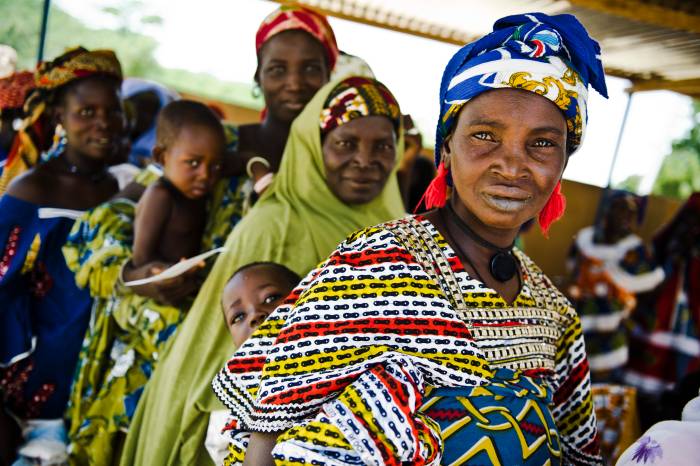
ODI website, November 7 2017. Image caption and credit: Women in Sebba, Burkina Faso, October 2012. WFP/Rein Skullerud, Flickr
- Log in to post comments