










































Harvesting from ict4ag Conference
MALAYSIA MSME News Network and Cameroonjournal
"Partnership is key. It takes partnership to have impact and it requires systematic extension. That is what we are expecting after the conference" - Benjamin Kwasi Addom, CTA ICT4D Programme Coordinator
This article was written by a journalist attending the International Conference on ICT4ag, which was co-hosted by the Technical Centre for Agricultural and Rural Cooperation (CTA) and the Rwandan Ministry of Agriculture and Animal Resources (MINAGRI), November 4-8 2013, Kigali, Rwanda. The event drew close to 500 participants from the government, private sector, non-governmental organisations (NGOs), intergovernmental bodies, and development agencies from 66 countries.
Reflecting on the conference, Arison Tamfu describes some of the discussions that took place there related to the use of information and communication technology (ICT) in the agricultural field in the African, Caribbean and Pacific (ACP) countries. One ACP country that hopes to "harvest from the conference and its aftermath is host country, Rwanda that seems to have fallen in love with ICTs. The presence of five government ministers and CEO [chief executive officer] of Rwanda Development board at the opening ceremony alone alludes to the importance the country attaches to ICTs." According to Ambassador Valentine Sendanyoye, agriculture "remains and will remain for sometime the biggest employer, the biggest contributor to GDP. So it is by applying ICTs advances and applications to this sector that we really can unleash the potential." That is why, in the assessment of Tamfu, Rwanda is eager to move from subsistence agriculture to profitable sustainable agriculture using ICTs; "the conference was rich in that regard with discovery of emerging innovations and focus on capacity building and enabling environment."
Tamfu shares news of a few specific technical applications (apps) that were presented at the conference. For example:
- Out of the Democratic Republic of the Congo (DRC), Mobile Agribiz is a new internet and SMS (short messaging service, or text) mobile app that allows smallholder farmers to get connected to buyers, learn about prices and where to sell, and helps them obtain skills on planting, fertilizer usage, and necessary information aggregates. CEO Narcisse Mbunzama said: "In the capital, Kinshasa we have succeeded to link over 400 farmers with about 100 buyers with this application and everybody, that is farmers and buyers are making money stress-free. In many cases we have raised farmers' incomes by 40 percent."
- Out of northeast India, m4agriNEI is a mobile-based platform, that, per Dr. Raj Saravanan, Associate Professor of Central Agricultural University, India, "cuts across the board: from ICT sectors and experts to rural and urban farmers reaching them with indispensible information. It blends all of them through the transmission of information through SMS, video, photos and voice from farmer to expert and then expert to farmer. Simply put, farmers subscribe to our system, send information about their activities and queries, experts then work on the concerns and reply back through designated farmer co-ordinators and rural youth."
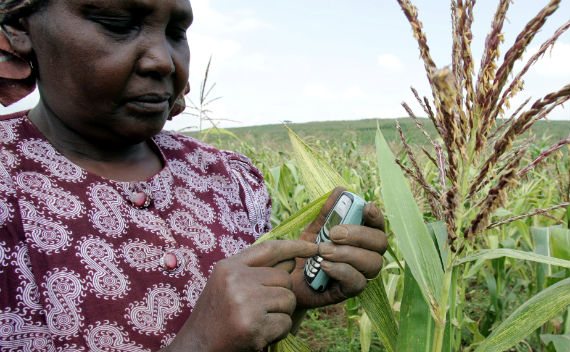
- Out of Kenya, iCow is a mobile phone app that helps small-scale farmers maximise their returns by providing advice on how to take care of the cows (information relating to calf health and nutrition, etc.). The farmers then access the information by subscribing to receive three SMSs a week at a cost of US$ 0.034 each per text. Susan Kahumbu Stephanou, CEO of iCow, claims that farmers' incomes have increased by US$30 per month, and milk production has stepped up from 2 to 3 litres daily "thanks to the service".
Citing developments such as those above, Tamfu noted: "It was obvious that the world is witnessing a surge of technological developments with the goal to boost agriculture, alleviate poverty and malnutrition. However some of the participants emphasized the need for 'business first, technology after' and the enhancement of a combination of the efforts of 'content experts and ICT experts'."
He also stressed this key message to emerge from the event: Young people and women need to be empowered with skills in ICTs and agriculture. Notes:
- On youth, who constitute "the chunk of Africa's population": "The conference itself attracted hundreds of young people from around the world enthusiastic about ICTs and agriculture. It is the case with young Joseph Macharia, founder and Director of ACLECOPS, a web-based system in Kenya that encourages young people to practice and earn a living from agriculture. 'All the workers of ACLECOPS are young. One thing I realized is that young Africans can earn a living out of agriculture' said Joseph Macharia." The conference included a "hackathon" that permitted ICT developers under the age of 30 to compete regionally by designing mobile apps for agricultural development.
- On women, who make up almost 50% of the agricultural labour force in sub-Saharan Africa: "Different success stories of how NGOs have trained women on ICTs usage in grassroots resulting in production were related but the challenges were amazingly similar. Whether Dorothy Okello of Women of Uganda Network Uganda or Nestor Ngouambe of TIC-DEV in Cameroon, all agreed that 'illiteracy and lack of finance' were standing on the way of expanding ICTs among rural women. A pointer to the need to initiate ways of reaching them."
Email from Stéphane Gambier to The Communication Initiative on December 6 2013. Image credit: Democracy in Development: Antony Njuguna/Courtesy Reuters
- Log in to post comments