










































Health Information Sources, Perceived Vaccination Benefits, and Maintenance of Childhood Vaccination Schedules
School of Journalism and Mass Communication, University of Wisconsin-Madison
Although childhood vaccine coverage is high overall in the United States (US), there are growing concerns about parental vaccine refusal. Misinformation about vaccination and autism has prompted concerns about the safety of recommended vaccinations and about recommended vaccination schedules. Vaccine-related (mis)information is available through mass and interpersonal communication sources, as well as social media. This study investigates the associations between evaluations of (the value respondents place on) health information sources, parental perceptions of childhood vaccination benefits, and the maintenance of vaccination schedules for their children.
Despite an abundance of scientific reviews rejecting a causal association between childhood vaccination and autism spectrum disorder advanced in the retracted 1998 Lancet publication by Wakefield and associates, concerns about a possible link have persisted among parents, sparking several measles outbreaks. Although worries that vaccines may cause learning disabilities such as autism are not the only reasons parents refuse vaccinations for their children, these concerns remain prominent, according to some researchers.
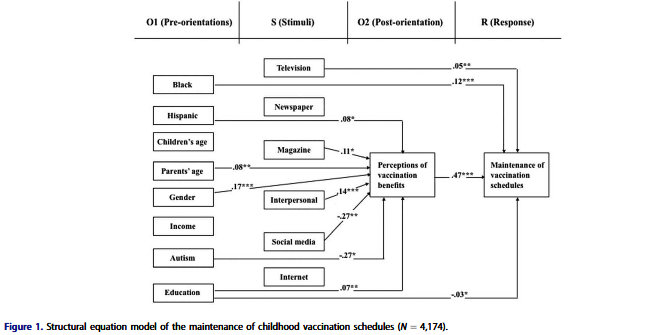
This study uses the O1-S-O2-R (Pre-orientation-Stimulus-Post-orientation-Response) model, which accounts for how parents' preexisting orientations, which include demographic and health-relevant variables, (O1) determine their evaluations of health information channels (S), which form their perceptions of childhood vaccination benefits (O2), and eventually influence their maintenance of childhood vaccination schedules (R).
The study drew on nationwide Multimedia Audience Research Systems (MARS) data that were collected from January 2013 to April 2013 by Kantar Media. A sample of 4,174 parents who have at least one child under the age of 18 was analysed, including 138 parents of households with a childhood autism diagnosis.
Interpreting the paths both from S to O2 and S to R, the researchers found that the values placed on magazines and interpersonal communication (with doctors, nurses, pharmacists, and friends) as health information sources were positively associated with parental perceptions of vaccination benefits, whereas the value placed on social media as sources of health information was negatively associated with perceptions of vaccination benefits. In addition, only the value placed on television as a health information source was positively related to the maintenance of vaccination schedules. In turn, parental perceptions of vaccination benefits were strongly associated with the maintenance of vaccination schedules.
With regard to the influence of demographic characteristics on parental perceptions of vaccination benefits and maintenance of vaccination schedules, female, Hispanic, older, and more educated respondents, as well as parents of children without autism, tended to perceive the benefits; Black respondents and those with less education were more likely to maintain vaccination schedules for their children. (Many of these effects sizes were quite small relative to the associations observed for health information sources, especially the comparatively large role of social media.)
Although parents of children diagnosed with autism are less likely to perceive vaccination benefits, no interaction effects with evaluations of health information sources were found on parental perceptions of vaccination benefits or maintenance of schedules. These results lead the researchers to conclude that parental perceptions and behaviours associated with information sources are not restricted to parents of children diagnosed or not diagnosed with autism.
In conclusion, the researchers suggest that the O1-S-O2-R model as an integrative theoretical framework represents parents' behavioural outcomes resulting from the cognitive processes caused by their evaluations of health information sources regarding childhood vaccination. Future studies could apply the O1-S-O2-R model to better understand the media's roles in public health decision-making or perceptions in health contexts other than vaccination. They also propose that researchers work to develop a more detailed typology of health information sources, with a particular focus on both social media and the internet, to understand the underlying dynamics influencing vaccination decisions.
Health Communication, DOI: 10.1080/10410236.2018.1481707.
- Log in to post comments