










































Impact Data - Tipping Point Bangladesh
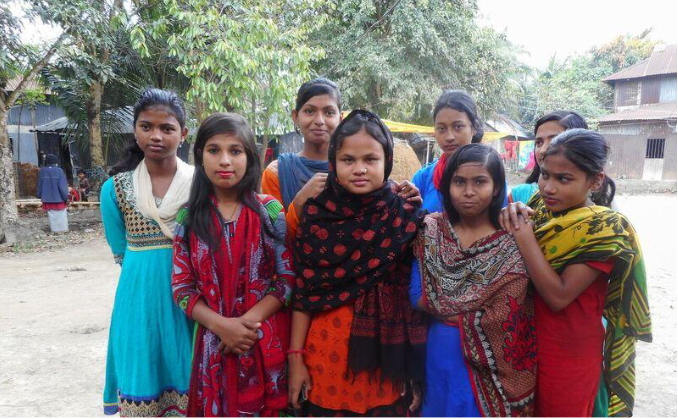
"These findings suggest conceptualization of female empowerment as requiring not only individual empowerment/achievement, but also societal and systemic change."
Bangladesh reports the fourth-highest prevalence of child marriage (CM) globally and the highest in South Asia, with 59% of the women aged 20-24 reported being married before the age of 18 and 19% before the age of 15. The International Center for Diaorrheal Research, Bangladesh (icddr,b) evaluated The Tipping Point Initiative (TPI), CARE's integrated social norms intervention to reduce CM by promoting adolescent girls' agency, creating supporting relations, and transforming norms driving CM. (See Related Summaries, below.)
In brief, TPI involved two holistic implementation packages, the Tipping Point Program (TPP) and Tipping Point Program Plus (TPP+). Both the intervention packages included a core set of interventions (e.g., group sessions) seeking to change girls', boys', and parents' behaviours and attitudes related to CM, while the TPP+ included an additional set of emphasised social norms change activities to support an enabling environment for community-level change. Overall, the approach is rooted in challenging social expectations and repressive norms and promoting movements and activism led by girls. These components are designed to help adolescent girls find places where they can reflect on and tackle inequality, and then take collective action on those issues.
TPI was implemented in 51 selected villages (17 per arm), in purposively selected Pirgacha upazila (sub-district) in Rangpur district in Bangladesh. The evaluation employed a mixed-method, three-arm (TPP, TPP+, and control) cluster randomised controlled trial (CRCT) design. A cohort of 25 randomly selected unmarried adolescent girls aged 12-16 years in each cluster was established, interviewed at baseline, provided with the intervention in the intervention clusters, and interviewed at endline. Randomly selected cross-sectional samples of adult female and male community members aged 25 or more were interviewed at baseline and endline surveys. Baseline data were collected during February-April 2019, and endline data were collected during November-December 2021. A TPI qualitative evaluation was conducted in 2 purposively selected villages from each of TPP and TPP+ arms during the same time frames.
The TPP+ intervention significantly increased girls' knowledge regarding sexual and reproductive health (B=0.61; 95% CI: 0.20, 1.02) and girls' participation in financial activities (B=0.26; 95% CI: 0.001, 0.53) compared to the control arm.
TPP+ intervention reduced the hazards of CM by 63% among girls who attended 36-40 sessions (out of a potential total of 40 sessions). However, there was no impact on the risk of CM when comparing the overall sample to the control arm.
Girls' mobility significantly increased over time across all arms - even in the control arm and even in the midst of COVID-19 lockdowns, but the mean score of girls' mobility only increased significantly among the girls who received 36-40 sessions in TPP+ arm (B=0.61; 95% CI: 0.098, 1.12) compared to those who did not receive any session.
The mean score of self-efficacy significantly increased among TPP+ participants who received 36-40 sessions (B=0.96; 95% CI: 0.11, 1.85), compared to those who did not receive any session. This was measured by asking a girl how confident she is in achieving life goals in education, healthcare, mobility, marriage, and income earning.
Girls' confidence in negotiation skills increased significantly among the girls who received 36-40 sessions in TPP+ arm compared to those who did not receive any session (B=0.43; 95% CI: 0.08, 0.78).
Positive attitudes regarding gender roles significantly increased among the girls who had high attendance (i.e., 31-35 sessions in TPP and 36-40 sessions in TPP and TPP+ arms). Girls' endorsement of control over girls by family members and justification of girl-beating were significantly reduced among the girls who received 36-40 sessions in TPP+ arm compared to those who did not receive any session.
Regression results did not show any significant impact of TP in increasing collective efficacy (girls' cohesion, solidarity, and mobilisation skills) among girls, and the qualitative data suggested that barriers like parents' disapproval and strong sanctions from community members, along with consideration of poverty and corruption, which facilitate CM discouraged most adolescent girls to raise a collective voice against it. All adult informants unanimously stated that any initiative to stop CM faced strong resistance from the parents. That said, a few instances of collective action to stop CM by TPI girls and boys were cited in the villages covered by the qualitative study, so the norms and behaviours related to girls' collective action went from non-existent at baseline to uncommon but more accepted at endline.
"Understanding the Impact of Addressing Root Causes of Child Marriage" [Tipping Point Global Impact Evaluation Summary], by Anne Sprinkel, Rajan Subedi, and Mahmud Khan, and "Year 9 | Impact Evaluation Fact Sheet: Findings from Rangpur, Bangladesh, 2019-2021" [Impact Evaluation Summary of Tipping Point Bangladesh] - both accessed on February 9 2023 and sourced from emails from Beth Sorel and Alessia Radice to The Communication Initiative on January 30 2023 and February 3 2023, respectively. Image credit: CARE
- Log in to post comments