










































Lessons Learned in Using Data in Polio Communications - How?
Maternal and Child Survival Program (MCSP) and John Snow, Inc. (JSI)
This presentation explores the global evolution of data-based polio communications and how that was implemented and monitored in/with countries, especially India and Nigeria. Some of the key steps in the movement of theory to data-informed practice on the road to polio eradication have been:
- Development of communication guidelines and checklists (including process and outcome indicators) in 2000 and onward;
- Training of communication experts and country teams in communication planning and strategy;
- Assessment of needs to improve behaviour change and communication;
- Application of communication and advocacy methods and utilisation of existing channels, media, and data; and
- Support for a cadre of field-based, local communication mobilisers for polio and beyond (e.g., the Social Mobilization Network, or SMNet, in India).
The challenge has been maintaining momentum for one initiative - polio eradication - while addressing broader health needs and priorities of underserved populations. Actions have included:
- Involving communities in defining how to address challenges;
- Monitoring communication activities through using and sharing data; and
- Strengthening communication for polio and associated services (e.g., routine immunisation (RI), child health, and water, sanitation, and hygiene, or WASH).
First, a look at the India experience, which has centred around:
- Linkage of polio eradication and communication monitoring data;
- Incorporation of communication data with RI and campaign tracking; and
- Strategic and regularly updated microplans, based on data and high-risk area prioritisation.
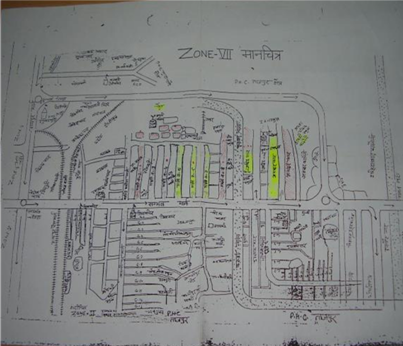
Communication through the SMNet is led by Community Mobilization Coordinators (CMCs), each of whom covers 400-500 houses. Subsequent slides show, for example, identification of high-risk areas by sub-block and resource/social mapping and child tracking, which involves:
- CMC neighbourhood map with numbered households and children; and
- Name-based register of children and tracking chart of polio doses circled for each round per child.
SMNet engages in booth days (multiple services) on Sunday and then house-to-house activities, Monday onward. There are transit teams and mobile teams, as well as a communication package for the 107 Block Plan. Revisits are planned on different days and at different times, and there is a continued focus on high-risk areas and populations.
Second, a look at the Nigeria experience, where the emphasis is on:
- Triangulating data from campaigns, surveillance, RI, and communication/community activities; and
- Development and monitoring of more detailed communication and community engagement indicators.
Subsequent slides share, for example, Nigeria national data, 2005-2010: cumulative routine immunisation coverage for all antigens and routine oral polio vaccine (OPV3) performance by state. Bauchi State is used to illustrate tracking of activities conducted from January - March 2011, including number of: ward coordination meetings planned and held, community meetings planned and held, influencers' meetings planned and held, mosque/church announcements planned and held, and RI sessions planned and supported. Also in Nigeria, there has been monitoring of the involvement of the community in helping to resolve polio campaign non-compliance cases, as well as multi-state linkages and measurement of engagement with other health interventions.
Editor's note: The above is a summary of a presentation delivered by Lora Shimp at Shifting Norms, Changing Behaviour, Amplifying Voice: What Works? The 2018 International Social and Behavior Change Communication (SBCC) Summit featuring Entertainment Education, held April 16-20 2018 in Nusa Dua, Indonesia.
Email from Lora Shimp to The Communication Initiative on May 2 2018. Image credit: Lora Shimp, JSI (taken during SMNet evaluation with CORE Group Polio Partners in India)
- Log in to post comments