










































Overcoming Violence: Exploring Masculinities, Violence, and Peacebuilding

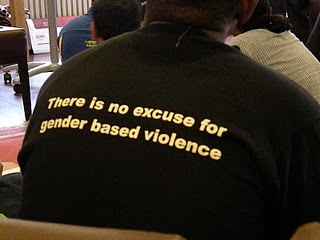
The Women Peacemakers Program (WPP) of the Netherlands-based International Fellowship of Reconciliation (IFOR) is convinced that in order to change cultures of war and violence, women peace activists need to work together with male allies. Therefore, the WPP organised an initiative revolving around 2 training-of-trainers (ToT) cycles for 19 activist men from 17 different countries, entitled "Overcoming Violence - Exploring Masculinities, Violence and Peace", the first of which took place from November 30 to December 11 2009 in the Netherlands. In July 2010, the participants returned for the second cycle of this pilot ToT to consolidate their learning and to address further training needs. The project aims to: train male trainers on gender-sensitive active non-violence (GSANV); explore the concept of masculinities in relation to issues of violence and peace; and create a pool of male gender-sensitive active nonviolence trainers.
To avoid working 2 weeks in a predominantly male-only setting, it was considered crucial to include women's experiences and perspectives related to peacebuilding various ways within the training. For instance, the male participants were asked to engage in a conversation with a group of women, prior to the training, to understand the women's situation in their communities better and to see in what ways women feel men could become better allies. The results of the surveys that the participants conducted with the women's groups were shared and discussed during the training.
Using interpersonal communication, printed material, and films, the first training cycle focused on: the theory and practice of active nonviolence (skills such as effective social mobilisation, conflict analysis models, and case studies of successful counter movements such as the Gandhian movement in India and the civil rights movement in the United States); facilitation and group dynamics; participatory teaching methods; conceptualising gender and diversity; leadership; women's rights; international instruments such as United Nations (UN) Security Council Resolutions 1325, 1820, 1888, and 1889; an introduction to and analysis of masculinities; and lobbying and advocacy.
After the opening session, the participants were invited to create a drawing about what it means for a man to be socialised to conform to hegemonic, dominant forms of masculinities and how that relates to women and femininities. The drawings were discussed in small groups, as well as in plenary.
Awareness was raised throughout the training about women's experiences in other ways, for instance through the use of resource material ("The WPP Training Handbook", "The WPP's ToT resource USB stick - Training Block 1", and audiovisual material and books on gender, women, peace and security, and active nonviolence), a visit to a conference focusing on women in war zones, the organisation of a cross-gender dialogue session, and by means of various exercises and discussions.
Films were used to spark discussion, as well. For example, Tough Guise: Violence, Media & the Crisis in Masculinity and Pray the Devil back to Hell, Weapon of War, A Force More Powerful, and Dangerous Lives: Coming out in the Developing World.
In one gathering, the group discussed what it is about a certain action that makes it "active nonviolent" and which cultural aspects play a role. For instance, in an Islamic context, threatening to take off one's veil could constitute an active nonviolence action. During that conversation, the 6 principles of nonviolence of Dr. Martin Luther King, Jr. served as a guideline for the discussion on the principles and steps involved in active nonviolence (information gathering and research to get the facts straight; education of adversaries and the public about the facts of the dispute; personal commitment to nonviolent attitudes and action; negotiation with the adversary in a spirit of goodwill to correct injustice; nonviolent direct action, such as marches, boycotts, mass demonstrations, picketing, sit-ins etc.; and reconciliation of adversaries in a win-win outcome in establishing a sense of community).
Participants created a statement entitled "Together for Transformation: A Call to Men and Boys" [PDF]: "....We strongly speak out against gender inequality and the discrimination of women in all forms, and we show our deep commitment to gender-sensitive active nonviolence as a way of life. We are inspired by and committed to this work and to the prospect of change in our lives and in our societies. We believe in people's capacity to bring transformative change in nonviolent ways..."
This first ToT cycle specifically focused on taking training ideas into action within participants' communities. For example, on the final training day, participants wrote a letter to home as a way of reflecting on the process of learning and personal transformation that had taken place during the training. They also discussed follow-up activities. For instance, one group introduced their ideas of working on awareness-raising (using psychodrama techniques) and on lobbying and advocacy of women's rights and gender roles and gender-based violence by educating people in their communities (e.g. journalists, rural people, students, and youth).
Upon returning home, each of the male participants was linked to a female support person ("ally") from his own region and/or country who supports him in the development and implementation of his follow-up plan. The follow-up activity is meant as an opportunity to practice the skills and knowledge acquired during the training and to spread the vision of the ToT within the participant's own network. It also serves as an opportunity for cross-gender dialogue and collaboration in which the complexities of gender inequalities and differences between male and female experiences and realities in a specific context can be exposed, challenged, and transformed. Both the male trainee and the female ally receive continuous support from the WPP throughout this process.
Also, a Google Group was created to facilitate the further networking and communication within the group of participants. The online group is being used for asking for advice, highlighting resources and news items, and sharing how they use the skills and knowledge they learned during the ToT cycle - including the gender-sensitive facilitation skills - in their work in their home context, and how they are spreading it within their own networks. Updates on the individual members' own work are provided through the list and compiled by the WPP. The WPP sends a monthly overview newsletter containing news items on its work as well as the compiled updates from the participants' work.
Gender, Rights.
Founded in 1919, IFOR is an international and interfaith peace movement of socially engaged citizens who commit themselves to active nonviolence as a way of life and as a means of transformation: personal, social, economic, and political. Established in 1997, the WPP works to support and empower women peace activists and actively advocates the recognition of women's experiences of war and conflict and the integration of a gender perspective in peacebuilding processes. The WPP has been organising ToT cycles for female peace activists since 2002. Women activists in the field repeatedly indicated that they lacked male supporters for their local peace work, which led to the initiative described above.
WPP's work is funded by the Netherlands' Ministry of Foreign Affairs.
"Overcoming Violence: Exploring Masculinities, Violence, and Peacebuilding" [PDF]; and WPP website and WPP blog - both accessed on December 14 2010.
Comments

Need of the Hour
The fight for justice of women. Free from male domination. Equality in all sector of living environment. A respect that befits the loyalty of innate rights expressed and translated in day today pragmatic live scenario will upbring peace and prosperity in the society. It is the need of the hours for all humanity to give space for all individuals not distorted by the illusion of gender discrimination.

- Log in to post comments