










































Peace Caravan

The 32-year-old woman at the centre of the effort explains the strategy as follows: "In the past, young people have been both the perpetrators and the victims of violence, but now we need to look to them to give a new direction to our country. Youth hold the future of Kenya. If you empower young people, you will empower the country as a whole."
Specifically, youth leaders from all the provinces (different tribal communities) of Kenya come together to join in the campaign for peace and reconciliation, going to the grassroots to showcase their solidarity and their brotherhood/sisterhood. The team travels for a number of days, making stop-overs in towns along the route, where they interact with the locals in peace-building activities such as theatrical and musical performances, sports activities, motivational talks, and dialogues. They also showcase cultural conflict resolution systems that they have learned from the different communities they have visited. The youth in the host communities also get an opportunity to showcase their own presentations and talk about the way forward in the reconciliation and peace-building process which they think will work best for their communities and which they will own and push forward successfully.
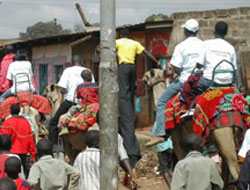
For example, in one 3-week-long 2008 tour, the team of 40-some youth leaders from all the provinces of Kenya on board travelled by camel - which is symbolic, a way of showing solidarity with, the ethnic groups in Kenya's northern desert areas. In addition to visiting villages, the youth team visited several camps for people who had been forced to leave their homes in the aftermath of the violence that followed the contested December 2007 election. At camps like that in Naivasha, a town that witnessed some of the worst violence, VYP encouraged young people to talk about how they had been affected by conflict, also urging them to think about how they could foster peace in their communities in the future.
Conflict, Youth.
- In 2004, VYP organised the first Peace Caravan - "We are the present and the future" - which reached about 100,000 people across Kenya's Rift Valley and Eastern and Central Provinces.
- In 2005, the Peace Caravan visited the Great lakes region of Uganda, Burundi, Rwanda, and Congo.
- In 2007, the Caravan crossed Kenya from Nairobi, Kisumu, and West Pokot to Mombasa.
- Following a disputed general election in December 2007, Kenya experienced political instability and widespread violence which cost the lives of more than 1,000 people and forced a further 500,000 to leave their homes. In response, 2008 saw 2 peace caravans. The first, "Vijana kwa Undugu Milele", travelled for 21 days from Nairobi to Naivasha, Nakuru, Molo, Kuresoi, Burnt Forest, Eldoret, Nandi Hill, Kericho, and Sotik - coming to an end in Kisumu. It is estimated that some half a million people saw the caravan during this 3-week tour. The second phase of this peace caravan took 15 days, and journeyed to Nairobi, Murang'a, Mukurweini, Nyeri, Nanyuki, Doldol, Isiolo, Archers, Losasia, Logologo, Hulahula, Marsabit, and Moyale.
VYP is supported by the United Kingdom (UK) Department for International Development (DFID).
DFID website, September 23 2008; and VYP website, February 19 2010. Photo credit: Edwin Nyandisi/VYP
- Log in to post comments