










































Predictors of HPV Knowledge and HPV Vaccine Awareness Among Women in Panama City, Panama
University of California Los Angeles, or UCLA (Gantz, de Herrera, Baezconde-Garbanati); women's health researcher (Calvo); University of South Florida (USF) Health Panama Offices (Hess-Holtz); ¡Libre del cigarrillo! (Gonzales); University of Panama (Alguero); Annenberg School for Communication, USC (Murphy); Johns Hopkins Bloomberg School of Public Health (Moran); Portland State University (Frank); Asian Institute of Technology (Chatterjee)
"The continued success of the HPV vaccination program in Panama will depend on maintaining high coverage, which has been shown to be linked to knowledge and acceptance among the target populations and their decision makers."
Studies indicate that even when practical barriers are eliminated, misinformation, stigma, lack of knowledge, and safety concerns can impede the success of a vaccine programme, highlighting the importance of understanding public perceptions of the human papillomavirus (HPV) vaccine to inform ongoing messaging via mass media and awareness campaigns to educate the public and dispel rumours. In that light, this study was conducted in 2013, after 5 years of national HPV vaccination of girls in Panama, among a diverse sample of Panamanian women aged 18-65. The purpose of the study was: (i) to analyse the relationship between reproductive health history and sociodemographic factors with women's knowledge of HPV and the HPV vaccine, and (ii) to measure acceptability of the HPV vaccine. The study also assessed preferred sources of health information, including frequency of internet use, to guide the creation of future public health educational campaigns and interventions.
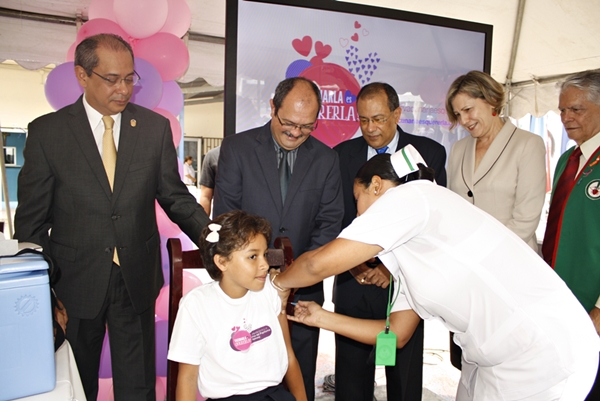
Through the National Immunization Program (Programa Ampliado de Inmunizaciones, or PAI), nurses deliver the HPV vaccine to 10-year-old girls (and now boys - see below) at no out-of-pocket cost through a primarily school-based programme, public and private. Data from other low- and middle-income countries (LMICs) supports the need for early and ongoing social mobilisation to increase awareness of the HPV vaccine to prevent incomplete vaccination. To that end, an awareness campaign was conducted that included advertisements through radio, television, newspapers, posters, and flyers in community health clinics, as well as charlas (informational talks) at community vaccine fairs. Many of the announcements featured the message "Vacunarla es quererla" ["To vaccinate her is to love her"] and featured images of mothers affectionately hugging their daughters next to a statement informing readers that the HPV vaccine prevents both cervical cancer and genital warts. Messaging from PAI about the HPV vaccine focused on cancer prevention, with little or no mention of its sexual transmission, a strategy that has been shown to be effective in avoiding stigma to the vaccine and in preventing confusion with other sexually transmitted infections (STIs).
Per media reports, the HPV vaccine programme was in general accepted by parents after its introduction. More recently, however, completion rates have waned; the completion rate for the HPV vaccine series among 10-year-old girls was 55.6% in 2016.
In this context, from October 2013 to December 2013, 333 women aged 18-65 with no history of cervical cancer who were seeking healthcare services in Panama City, Panama (for themselves or a family member) completed a verbal survey in Spanish.
Although 93% of respondents had heard of HPV, understanding of the sexually transmitted nature of HPV and knowledge of strategies to prevent HPV transmission was more limited. Furthermore, only 59.8% had heard of the HPV vaccine, and practical knowledge of where and how to receive the vaccine (such as number of required doses) was poor. This may indicate a need to explore and evaluate the efficacy and impact of prior health education and communication strategies, as data from Latinas in the United States have indicated an association between having heard of HPV and the HPV vaccine and vaccine uptake.
Despite limited knowledge, acceptability of HPV vaccination of daughters was high (95%), which the researchers indicate may reflect a sense of trust in the PAI, an organisation that has been well established in Panama for over 50 years and has engaged with the community through health fairs, with an emphasis on equal access for all. Among the 17 women who did not accept the HPV vaccine, reasons for hesitation or refusal included: daughter is too young (11.8%), concern for side effects (35.3%), lack of knowledge/information regarding vaccine (11.8%), concern it might promote sex (11.8%), perceived opposition from spouse and/or family (5.9%), and don't know/refuse to answer (25.5%). Participants were also asked whether they felt the father of their daughter would approve of her receiving the vaccine: 295 (88.6%) responded "yes".
When asked about internet use, 43.54% of respondents had not utilised an internet connection in the past week, and 31.83% had accessed the internet at least once daily. When asked to name preferred sources of health information, the most common answers were internet (48.0%) and television (29.7%). Print materials were named less frequently, including books/magazines (7.2%), newspapers (4.8%), and pamphlets (3.6%). These findings highlight an opportunity for online and multimedia educational materials, which can be an effective and inexpensive way to reach large geographic areas.
More than half (60.0%) of participants reported government health centres as their preferred site for health care, making the health centres possible venues for the delivery of educational materials.
In multivariate analyses, HPV vaccine awareness was associated with age and education, but not with income, internet use as preferred source of health information, indigenous race, or marital status. In addition, after controlling for age, education, income, race, and internet use, women who completed a pap test in the past 36 months were 3.12 times more likely to have heard of the HPV vaccine when compared to those who had not (95% confidence interval (CI) 1.04-9.34). This suggests that healthcare visits for parents might be an opportunity for counseling from medical providers, or that women who consider preventive healthcare activities important for themselves also consider them important for their children.
In order to address the aforementioned knowledge gaps in the community, the researchers suggest that comprehensive educational campaigns are needed at local, regional, and national levels. They suggest that educational materials should take into account Panama's history and cultural and ethnic diversity, including indigenous populations. Another consideration relates to the fact that, while only a small minority of participants in this study cited hesitation to vaccination due to the sexual nature of the vaccine, future educational campaigns may need to consider the role of religion and morality in shaping public perceptions of vaccines.
In 2016, in response to increasing demand in the community, the PAI began also offering free vaccination against HPV for all boys at age 10. Although the researchers did not ask about HPV vaccine acceptability for boys to avoid confusion (given it was offered only to girls at the time of the study), the data could be used to inform the creation of new and updated materials that reflect the universal vaccination of all 10-year-old children in Panama. "Future studies should incorporate randomized sampling to involve women outside of the health-care system, and should also explore acceptability of HPV vaccination for boys and perceptions of HPV and HPV vaccine among men, who are also at risk for HPV-related cancers."
World Medical & Health Policy, Volume 11, Issue 1. https://doi.org/10.1002/wmh3.293. Image credit: PAHO
- Log in to post comments