










































Second European Congress on Media Literacy

EuroMeduc is a European exchange network for media literacy working to support the effective and integrated development of media literacy and to see it become more widespread and implemented throughout Europe. With support from the European Commission (Lifelong Learning Programme), the 4 EuroMeduc partners (Média Animation, CLEMI (Centre de Liaison de l'Enseignement et des Médias d'Information), Zaffiria, and the University of Algarve) have developed a strategy for sparking exchanges, reflection, recommendation, and action based on the organising of seminars and "congresses" in order to collaboratively address the major issues concerning media literacy in Europe.
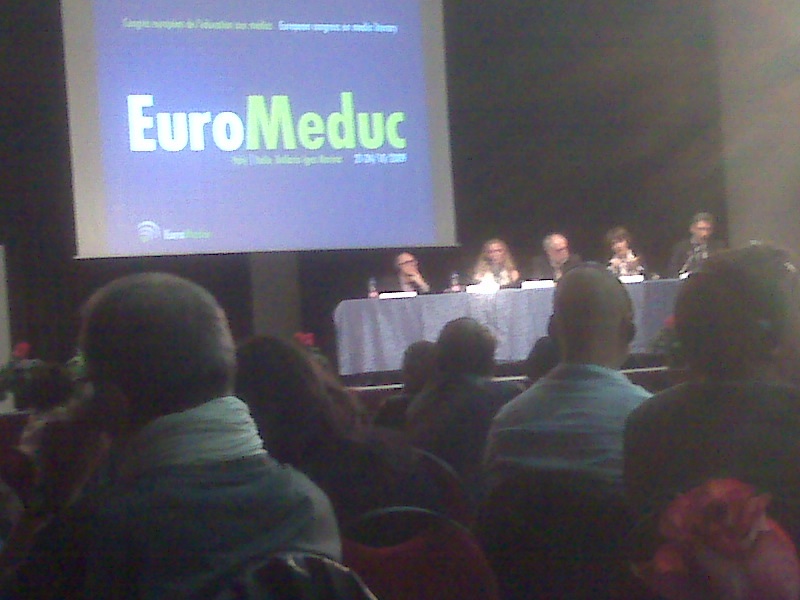
This strategy for addressing 3 precepts related to media literacy - opportunities, obstacles, and actions to be taken - began with the first European Congress on Media Literacy, held in Belfast, Northern Ireland, in 2004. Euromeduc then organised a second Congress for further exchange and reflection amongst: professionals, researchers, and other practitioners involved in media education; policy-makers in education and politics; and representatives from the media industry and the European institutions. Special attention was given to fostering the active inclusion of small education bodies, due to their hands-on experience and their perceived insight on strategies for enhancing the quality and relevance of literacy projects. More than 350 experts from 30 countries met in Bellaria, Italy, from October 21-24 2009 for the fourth and final event, building on seminars that had been held in:
- Paris, France (June 30 - July 2 2008), where the focus was on media literacy as resulting from media production by youth (both in- and out-of-school).
- Brussels, Belgium (November 17-19 2008), where the focus was on lifelong media literacy: innovative practices beyond school.
- Faro, Portugal (February 16-18 2009), where the focus was on media literacy and internet appropriation by youth.
Participants in October 2009's Bellaria Congress worked together on 70 recommendations, which are collected in the publication "Media Literacy in Europe: Controversies, Challenges and Perspectives". Published in December 2009 (available in English and French), this 192-page resource is a strategy for feeding the results of the dialogues to existing networks and fostering more intensive, better-structured exchanges. It features a summary of contributions on the various topics addressed in the course of the 3 preparatory seminars, articles on leading issues discussed in Bellaria, and the set of 70 recommendations agreed by all participants at the end of the Congress.
The publication's preface illustrates EuroMeduc's approach to media literacy, and complexities created by intersections with new information and communication technology (ICT). It was penned by the European Union (EU) Commissioner for Information Society and Media, who stresses that "Media literacy is a paramount goal of the EU's public policy." Here is an excerpt from her preface:
"Digital technologies have made media truly ubiquitous. Whether originated in established publishers or created by users, media content permeates and informs every aspect of our life. Yet, in order to make the most of the wealth of content available to them, people need to be able to make out what they wish from what they don't, what is suitable from what isn't....This is where media literacy comes into play. The challenge is daunting. Target constituencies keep growing and moving as 'digital migrants' try to catch up with 'digital natives', as unfettered creativity seems to give media content new shapes or take it along new paths almost every day. However tall the order might be, media literacy is a paramount goal of public policy if all European citizens are to enjoy the benefits of the Information Society fully...
...This background explains why the debates that took place on October 21-24 in Bellaria under the auspices of EuroMeduc are so important. The attached proceedings reflect the breadth and depth of the thinking process that has been at work to redesign the media literacy of the 21st century and to provide it with the most effective tools. In this respect, I am happy to see that the empowerment made possible by the so-called participatory Web is now fully integrated so as to make the education core of media literacy even more meaningful."
News on Children, Youth and Media in the World No. 2, 2009, from the International Clearinghouse on Children, Youth and Media, forwarded to the Young People's Media Network (YPMN) listserv, February 11 2010; and EuroMeduc website, February 12 2010. Image courtesy of Renee Hobbs
- Log in to post comments