










































Haba na Haba

Haba na Haba, Swahili for "step by step," describes the approach that the group takes in their mission to provide people in Nairobi and outlying areas with information to provoke debate on social issues and healthy alternatives to crime, drugs, and other destructive behaviours. Their message is that all things are possible if you take them one step at a time.
The project supports vikundi (or, art groups) divided into different age groups in 7 slum areas by conducting trainings in dance, drama and puppetry, music, and acrobatics. In addition, the project provides the various vikundi with instruments and costumes for performances.
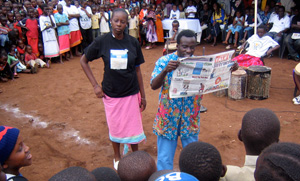
Every Saturday the project holds a two-hour participatory educational theatre show, which includes acrobatics, music, dance, and drama. In order to reach both the young and the old, these shows are mainly staged near a market. The skits (short plays) developed are participatory, and the audience maintains the power to decide what direction the skit should take. This allows open communication between community members and the performers. Usually a discussion erupts, which gives project peer educators and counsellors an opportunity to elaborate further about the issues affecting the community. On several occasions the project has performed for audiences of up to 1,000 people.
The project also conducts participatory educative theatre performances in schools, often about reproductive health. Teachers and students attend the shows, which encourages discussion between the performers, teachers, and students.
The project uses dance, music, drama, and acrobatics as it believes that this is the most effective and entertaining way to exchange important information. These activities also offer youth a chance to develop, to express creativity, and to showcase skills and special talents. According to MYSA, all these help in personal development - physically, mentally, and creatively.
The arts are also seen to promote social integration. Just like sport, the arts draw a big audience and can therefore promote unity and solidarity amongst generations. The organisers also believe that the arts have the ability to erase differences in race, religion, gender, age, political affiliations, etc.
In addition, the history of many African communities is not documented; the arts have provided a means of passing information from one generation to the next. The Haba na Haba project has therefore used familiar folk media to convey information to the community.
The MYSA office has an interactive wall, managed in conjunction with the Kuona Trust, a network of Kenyan artists, who repaint the wall quarterly. Subjects include: women's empowerment; rape; education; and alcohol and drug abuse information. Images are the main focus, since not everyone can read in English and/or Swahili. At the end of the wall is a small blackboard where comments may be written. MYSA is hoping to expand such interactive walls into neighbouring communities.
Youth, HIV/AIDS, Reproductive Health
The project's achievements include:
- The Haba na Haba Project has approximately 1,000 members.
- Over 300,000 people have attended participatory educative theatres and school interactive theatres since 1999.
- Over the years, several youth who have been associated with the project have appeared on TV, in movies, and in the theatre, as actors, dancers, musicians, and choreographers.
- The group has produced two music CDs.
- Haba na Haba has participated in international cultural exchanges, such as one by a 9-member Haba na Haba touring ensemble in March 2009. The group visited Washington University in St. Louis (Missouri, United States). One professor there commented, "The courageous and thought-provoking work of Haba na Haba in some of the most economically challenged areas in and around Nairobi demonstrates ways in which the performing arts can educate people from all walks of life and truly effect social change. Their magnetic capacity to summon and sustain a theatrical audience in village and town squares with their medley of acrobatics, music, dance, and drama can teach westerners that theater, looked at from a global perspective, can be much bigger than the well-lit stage."
Stromme Foundation, Kuona Trust, Sarakasi Trust, Hulebeck High School in Sweden. African Arts and Dance into Space Contemporary Dance companies, Barn er Bra Festival in Norway, and schools in Mathare and neighbouring slums.
MYSA website on August 28 2006; and "Kenyan Performance Group Haba na Haba to Visit WUSTL March 13-22". Photo by Reynolds Whalen.
- Log in to post comments