










































The Access Road
United Villages, Inc.
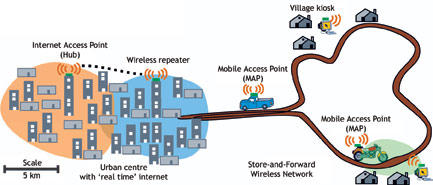
This ICT Update article describes a communication system that links internet kiosks in rural communities near Kigali, Rwanda, and in India, Paraguay, and Cambodia with a hub computer system that can provide reliable, often high-bandwidth, internet. The link is a new technology from United Villages company called Daknet that makes use of a combination of Wi-Fi and Voice over Internet Protocol (VoIP) and reaches the villages by using existing transport infrastructure.
DakNet creates Village Area Networks (VAN) of 10 or fewer kiosk computers through a Mobile Access Point (MAP), a small box which can be placed inside any vehicle - on a bus, inside a car, or on the back of a motorbike - to collect data through a Wi-Fi antenna attached to the village kiosk computer up to 500 metres from the road. As the vehicle completes its circuit from village to village, it will automatically forward the information collected to the hub system, which then sends the messages. Simultaneously the device receives stored replies to distribute on the same route.
"In addition to email and cached web searches, this system also gives villagers the opportunity to send and receive voice and text messages to and from any phone by using a combination of Voice Over Internet Protocol (VoIP) telephony, traditional landline telephony, and SMS text services. This ‘Voice Mail Over IP’ (VMoIP) solution turns each village PC into a virtual phone booth. Customers can send and receive voice mails through a publicly available phone at each village PC or use cordless phones to access their voice mail within a limited radius from each computer kiosk. Users can create voice mail boxes, similar to an email inbox, through which they can send and receive voice mails to and from cellular and landline telephones. Using the numbered keypad of a standard telephone handset, people can communicate in their mother tongue with anyone else who has a phone number. VMoIP therefore reduces the literacy requirements while connecting users into traditional telephone networks."
The voice mail system is delivered and received in much the same way as email. However, when it is transmitted from the hub computer and reaches an internet link, it is delivered to its destination phone number. For voice mails sent to mobile phones, a Short Message System [SMS] message can be sent to notify recipients to call a number to retrieve the entire voice mail. When sent to landline telephones, the voice mails can be delivered either in their entirety or a short preview can be delivered with directions on how to retrieve the complete message.
"Typically, voice mails for local telephone numbers are delivered over standard telephone networks and national (where legal) and international messages are delivered using VoIP. There is also the possibility for users of the VMoIP service to have a [sic.] phone numbers wherever there is a server in order to be reachable on a local phone number, keeping the cost low for friends or family who want to call back."
The availability of prepaid cards at computer kiosks provides a prepayment method. First-time users buy an identity card with a password that activates an email account. These cards can be recharged with credit. "The denominations, currencies, and formats of the prepaid cards are fully customizable to fit in with the tariff structure..." for each service in each country. "Additional services can also be integrated into the system, such as e-commerce, micro-credit and telemedicine....By recovering costs in this way, DakNet becomes an economically viable method of distributing bandwidth by making use of existing communication and transportation infrastructures."
ICT Update website Issue 41: February 2008, accessed on May 5 2008.
- Log in to post comments