










































Kibing HIV Awareness Films

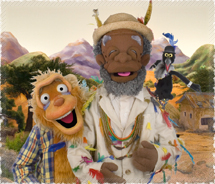
The central character of the films is the mysterious Kibii Kabooka Kibing who appears, from nowhere, with his speaking crow and monkey, on the pretext of offering big money prizes to the lucky ones chosen to play one of their three games. In reality, their aim is to make that person – the learning character – confront their prejudices or lack of awareness about HIV. In each film, taking part in the game leads to a change of attitude and an accumulation of wisdom, allowing that person to make better choices that will help them stay healthy, and to be more thoughtful of others in their community.
According to the producers, the learning character in each film is key to stimulating reflection about certain behaviours which in turn can lead to a change in behaviour. In each film the learning character undergoes the main change in attitude and through them the viewer also challenges the way they approach things. Although the characters are generally likeable, the viewer realises that this does not mean that one cannot be critical of these characters – because they lack awareness, they do lots of things that can be harmful to themselves or to those around them.
Although the films are intended primarily for children, they could be equally effective for older children and even adults, where they can be used to inspire a more complex and mature analysis of the pressures, problems, and anxieties they may face.
The following are the story outlines of the three films, each focusing on a particular issue - stigma, prevention, and gender equality:
Do You Know It All? (Stigma) This film features Simon Mukuba who thinks he knows a lot about HIV/AIDS. He makes it his business to share that knowledge with everyone else so that they don’t get infected. He tells everyone that HIV is a curse and caused by evil spirits and that one can even get it from touching a ball an orphaned boy has kicked. When Kibii Kabooka Kibing appears through his cloud of dust, it is Simon he picks to play the big cash prize "Do You Know It All" challenge. The wheel spins, the crowd holds its breath, and it stops at the HIV sign. For each correct answer, Simon keeps a $100 bill, and for each incorrect answer, the crow snatches it away. Needless to say, his first three answers are hopelessly wrong. The final question is: Is Simon Mukuba HIV positive? He says he is not as he is healthy as a buffalo. But as Kibing points out, there is no way of knowing unless one is tested. Simon loses the game, but both he and the other villagers are made to reflect on the fact that perhaps people living with HIV or AIDS deserve their support, not their fear, and that they should all get tested as testing means you can get medicines and stop the virus from spreading.
Will This Be Your Life? (Prevention) This film is about young Daisy Johnson. When walking home from school with her friend, Frances, and little brother, Daniel, she is flattered when Clifford, a guy on a motorbike, wants to talk to her. Rita and Tanya, the cool slightly older girls, are smoking cigarettes and watching. Daisy wants to be like them. When Kibing appears and offers her the amazing opportunity to choose between two futures, represented by Clifford, or Frances and Daniel, she does not hesitate and chooses the "cool" lifestyle. She is given a magical Return Button: at any point she can press it and return to the present with no harm done. At first, things seem great. Daisy grows up fast, smoking, drinking, hanging out in bars. Then she gets pregnant, loses her Return Button, and finds out she is HIV positive, even though Clifford seemed so healthy. With only Clifford to turn to, she arrives to find him disgusted, flinging her old school bag out of his house. Inside the school bag she finds the Return Button, and Daisy is able to go back to the present and to Frances and Daniel. She tells all her friends her story and warns them that they do not have the luxury of a Return Button.
The 24 Hour Challenge (Gender Equality) This film is about Joseph and Matthew who are two ordinary young school friends without a care in the world. They dream of motorbikes and cell phones and new sunglasses. They have no idea that each of their older sisters would love the same opportunity to go to school and that one of them is due to marry a much older man the very next day, and the other is plagued by the attentions of a lustful young drunk, Ruti. Kibing’s lesson takes the form of the 24-Hour Challenge. If each boy agrees to spend 24 hours as their sisters, the boys can have bikes and phones to their hearts’ content. When the exchange happens, Joseph is horrified to find he’s about to be wed the next day, and Matthew is terrified by Ruti’s menacing advances. In addition, both situations carry a risk of HIV. The police blame the ‘girls’ for being out late when they try to complain. With the fiancé and Ruti hot on their tails, there is only one thing to do - go back to Kibing and admit defeat, a mere 12 hours into the challenge. They realise, however, that it is their sisters who are the real losers and for whom life can be very unfair. They form a pressure group, seeking fairness and equality for all.
To date, the films have been dubbed in Swahili, Luganda, and African English dialect, with French, Kikongo, and Lingala versions currently nearing completion and with more languages to follow.
According to the producers, the films are culturally sensitive, with characters and sets familiar to their target audiences. The message content was developed with local partners in sub-Saharan Africa, many of whom are now active in their dissemination. The shoot took place at the Henson Studio Annex in New York City, NY, United States, in May 2009, with two of the No Strings in-country team there to provide advice on content, assist with arising issues relating to cultural sensitivity, and to ensure the films are created in line with full expectations of local partner experts.
As an educational tool, the No Strings films are intended to be used as an engaging means to present vital information that leads to further discussion and reflection. The stories present many important issues, and the characters are meant to form easy reference points for an exploration of real-life issues. Children watch the films in groups, and a visiting trained facilitator takes them on the journey from the film's fantasy world to the real world. Facilitators are trained during in-country No Strings workshops. Facilitators may be field workers with local partner organisations or teachers. They may be sent to attend a No Strings workshop in person, or they may be trained in subsequent sessions run by more senior staff who have themselves attended the No Strings workshop for training of trainers. As part of the workshop, No Strings also sends two leading puppeteers to conduct hand puppet training classes so that facilitators can introduce characters for specific educational roles which help reinforce their learning and deepen their understanding of the many pressures, fears, and sense of isolation that young people may experience. Locally-produced hand puppets are provided, along with a facilitator’s guide detailing the overall methodology.
No Strings held a five-day facilitators workshop in October 2009 for 36 delegates from Trócaire’s local partner organisations in 8 sub-Saharan African countries: Kenya, Uganda, Tanzania, Ethiopia, Democratic Republic of Congo (DRC), Mozambique, Angola, and Zimbabwe.
An assessment visit was conducted in March 2010, in which a number of partners using the films in Kenya and Uganda were visited. Findings from the assessment were incorporated into a Facilitator's Guide and Training Manual, which were distributed to facilitators using the programme.
Click here to view photos from the production on Flickr.
HIV/AIDS and Gender
Now registered in three countries, No Strings was founded six years ago by some of the staff from the original Muppet Show, Fraggle Rock, and many other TV and film favourites, and an experienced humanitarian aid team. Their work is based on a simple idea - how to get through to people with crucial information in a way they will enjoy, engage with, and remember. No Strings works globally to create films that challenge behaviours linked to issues such as peace building, HIV/AIDS, health, and safety.
No Strings films are being used by organisations such as Trócaire, Plan International, the International Organisation for Migration, and Save the Children, while in the Philippines, their natural disasters-awareness programme is being incorporated by the Department of Education as part of the national curriculum across the schools system.
No Strings International and Trócaire.
AIDSAlliance Blog, and email from Rosie Waller to Soul Beat Africa on September 3 2010.
(Photo by: Jeffery Price)
- Log in to post comments