










































South Africa Mobile Library Project
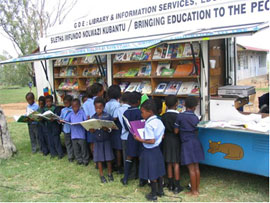
The project acquired used mobile library vehicles through donations from Japan and brought them into South Africa, where provincial departments of education operate them to provide book loans to children and teachers at primary and middle schools. The mobile libraries visit the recipient schools twice every school term (the South African school year is divided into four terms) to loan and collect books. Librarians travel on board the vehicles, and advise teachers at the schools how to select the appropriate books and use them in their lessons. According to the organisers, not only do the children gain an opportunity to interact with a diverse range of books, but teachers are also able to learn how to utilise the materials and maximise their potential. SAPESI is working with the South African Department of Education to support provincial departments of education with the import procedures, operation, and management of the mobile libraries.
SAPESI is also supporting the preservation of South Africa's indigenous languages through its mobile library activities. With contributions from the Sony corporation, they have purchased books in indigenous languages, which are sent to schools on the mobile libraries.
Education, Literacy
In 2007, there were a total of 19 mobile library units operated as part the South Africa Mobile Library Project, which visited 455 schools.
According to the organisers, while initiatives carried out by the South African government have led to a primary school enrollment ratio exceeding 87%, the access to books - an indispensable tool for literacy education - is limited, and the percentage of schools possessing a library is very low.
The organisers say that South Africa has 11 official languages (including 9 indigenous languages), but books written in its indigenous languages are especially scarce. Of the 9 years of compulsory education received by South African children, the first 2 years are spent learning to read and write one of the country's official languages, but from the third year onward almost all lessons are carried out in English. Apart from Afrikaans (derived from Dutch) and English, 9 of South Africa's 11 official languages are indigenous languages that have been handed down by word of mouth. With only a limited quantity of materials written in these languages remaining, there are concerns that some of them may fade out. At the same time, some students struggle to adapt to English, which starts from their third year; they may leave school without completing their education. This has led to action from government and non-governmental organisations (NGOs) to promote the uptake of books in both English and indigenous languages.
Sony, South Africa Primary Education Support Initiative (SAPESI), South African Department of Education.
Sony website on July 30 2009.
Comments

Congratulations
Iam impressd with what you have done. Please extend to us. I was thinking about this programme but nobody is coming forward. My contact details are as follows Mr Chiza Herbert Longwe Malawi Human Righs Resource Centre
Box 891 Lilongwe
alawi. I would like to open a child/s library at Nkhorongo Primary school and surrounding areas. Greetings
Chiza Herbert Longwe
Letter of Partnership
Dear Sir/Madam,
LETTET OF PARTNERSHIP
Humanitarian Agency for Child Protection and poverty Alleviation (HACIPPA) is independent, non-partisan, and non-profit organization based in Brikama, The Gambia.
HACIPPA seeks to amplify a conscience base world in which no one is subjected to human rights abuse; violence, rape, lack of quality education rather promote the mobilization of the limited resources available to foster global development which is the genesis of good governance, humanitarian agencies, well wishers and a catalyst to peace and stability in the world; all based on equity and mutual respect.
In view of the above, HACIPPA wish to write to your office for partnership on Mobile Libery Project in order to serve as a remedy for the less privileged children in The Gambia to restore their last hope on their rights and dignity which are the foundations of freedom, justice and peace in the world.
I look forward to hearing from your reply
Yours faithfully,
Mohamed F. Kamara
Director
- Log in to post comments