










































Lancet Series on Gender Equality, Norms, and Health
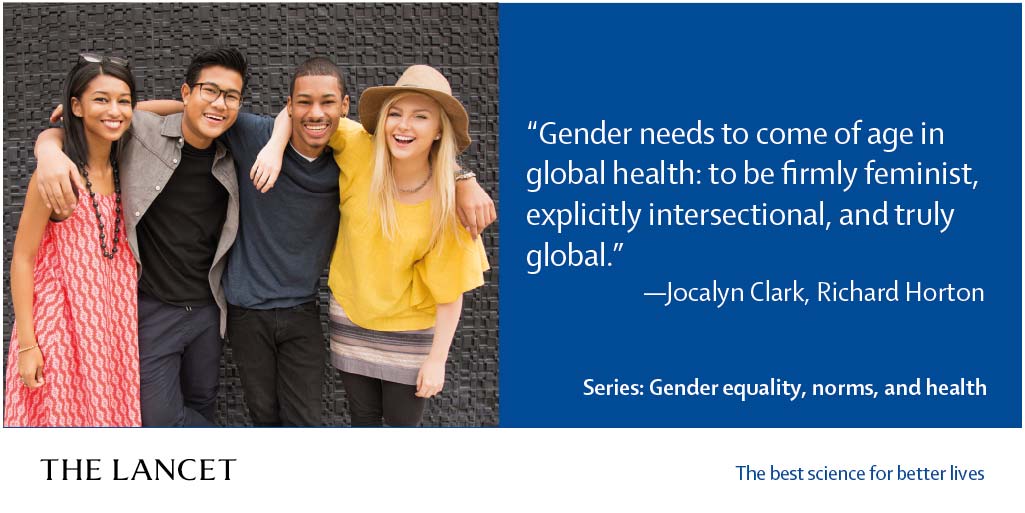
"This Series aims to inform the global health community of the critical need and effective actions to recognise and transform restrictive gender norms and gender inequalities, and their intersections with other social inequalities - including those related to age, race/ethnicity, religion, and socioeconomic status - in all they do."
This journal Series on Gender Equality, Norms, and Health, published by The Lancet as part of their Global health Series, consists of a collection of five papers led by Gary Darmstadt (from the Department of Pediatrics and the Center for Population Health Sciences, Stanford University School of Medicine) and colleagues. It seeks to provide analysis and insights into the impact of gender inequalities and norms on health, and the opportunities that exist within health systems, programmes, policies, and research to transform gender norms and inequalities.
As mentioned in the introduction to this Series, "The need for more action and accountability on gender equality is clear: introduction of the 2030 Agenda for Sustainable Development and the Universal Health Coverage goals demand greater attention to the social determinants of health, including gender, for the purpose of enabling all people to reach their full human potential. The systemic neglect of gender norms and inequalities in programme design, implementation, monitoring, and evaluation undermine the health of everyone - women and girls, boys and men, and gender minorities."
The five articles are as follows:
Gender inequality and restrictive gender norms: framing the challenges to health - by Lori Heise, Margaret E Greene, Neisha Opper, Maria Stavropoulou, Caroline Harper, Marcos Nascimento, and Debrework Zewdie on behalf of the Gender Equality, Norms, and Health Steering Committee
- From the abstract: "This paper...investigates the relationships between gender inequality, restrictive gender norms, and health and wellbeing. Building upon past work, we offer a consolidated conceptual framework that shows how individuals born biologically male or female develop into gendered beings, and how sexism and patriarchy intersect with other forms of discrimination, such as racism, classism, and homophobia, to structure pathways to poor health. We discuss the ample evidence showing the far-reaching consequences of these pathways, including how gender inequality and restrictive gender norms impact health through differential exposures, health-related behaviours and access to care, as well as how gender-biased health research and health-care systems reinforce and reproduce gender inequalities, with serious implications for health. The cumulative consequences of structured disadvantage, mediated through discriminatory laws, policies, and institutions, as well as diet, stress, substance use, and environmental toxins, have triggered important discussions about the role of social injustice in the creation and maintenance of health inequities, especially along racial and socioeconomic lines. This Series paper raises the parallel question of whether discrimination based on gender likewise becomes embodied, with negative consequences for health. For decades, advocates have worked to eliminate gender discrimination in global health, with only modest success. A new plan and new political commitment are needed if these global health aspirations and the wider Sustainable Development Goals of the UN are to be achieved."
Gender norms and health: insights from global survey data - by Ann M Weber, Beniamino Cislaghi, Valerie Meausoone, Safa Abdalla, Iván Mejía-Guevara, Pooja Loftus, Emma Hallgren, Ilana Seff, Lindsay Stark, Cesar G Victora, Romina Buffarini, Aluísio J D Barros, Benjamin W Domingue, Devika Bhushan, Ribhav Gupta, Jason M Nagata, Holly B Shakya, Linda M Richter, Shane A Norris, Thoai D Ngo, Sophia Chae, Nicole Haberland, Katharine McCarthy, Mark R Cullen, and Gary L Darmstadt on behalf of the Gender Equality, Norms and Health Steering Committee
- Abstract: "Despite global commitments to achieving gender equality and improving health and wellbeing for all, quantitative data and methods to precisely estimate the effect of gender norms on health inequities are underdeveloped. Nonetheless, existing global, national, and subnational data provide some key opportunities for testing associations between gender norms and health. Using innovative approaches to analysing proxies for gender norms, we generated evidence that gender norms impact the health of women and men across life stages, health sectors, and world regions. Six case studies showed that: (1) gender norms are complex and can intersect with other social factors to impact health over the life course; (2) early gender-normative influences by parents and peers can have multiple and differing health consequences for girls and boys; (3) non-conformity with, and transgression of, gender norms can be harmful to health, particularly when they trigger negative sanctions; and (4) the impact of gender norms on health can be context-specific, demanding care when designing effective gender-transformative health policies and programmes. Limitations of survey-based data are described that resulted in missed opportunities for investigating certain populations and domains. Recommendations for optimising and advancing research on the health impacts of gender norms are made."
Improving health with programmatic, legal, and policy approaches to reduce gender inequality and change restrictive gender norms - by Jody Heymann, Jessica K Levy, Bijetri Bose, Vanessa Ríos-Salas, Yehualashet Mekonen, Hema Swaminathan, Negar Omidakhsh, Adva Gadoth, Kate Huh, Margaret E Greene, Gary L Darmstadt on behalf of the Gender Equality, Norms and Health Steering Committee
- Abstract: "Evidence that gender inequalities and restrictive norms adversely affect health is extensive; however, far less research has focused on testing solutions. We first comprehensively reviewed the peer-reviewed and grey literature for rigorously evaluated programmes that aimed to reduce gender inequality and restrictive gender norms and improve health. We identified four mutually reinforcing factors underpinning change: (1) multisectoral action, (2) multilevel, multistakeholder involvement, (3) diversified programming, and (4) social participation and empowerment. Following this review, because little research has investigated the effects of national-level law and policy reforms, we conducted original quasi-experimental studies on laws and policies related to education, work, and income, all social determinants of health in which deep gender inequalities exist. We examined whether the laws and policies significantly affected health outcomes and gender norms, and whether law-induced and policy-induced changes in gender norms mediated the health effects, in areas for which longitudinal data existed. Laws and policies that made primary education tuition-free (13 intervention countries with the law and/or policy and ten control countries without) and that provided paid maternity and parental leave (seven intervention and 15 control countries) significantly improved women's and their children's health (odds ratios [OR] of 1.16-2.10, depending on health outcome) and gender equality in household decision making (OR 1.46 for tuition-free and 1.45 for paid maternity and parental leave) as a proxy indicator of gender norms. Increased equality partially mediated the positive effects on health outcomes. We conclude by discussing examples of how improved governance can support gender-equitable laws, policies, and programmes, immediate next steps, and future research needs."
Disrupting gender norms in health systems: making the case for change - by Katherine Hay, Lotus McDougal, Valerie Percival, Sarah Henry, Jeni Klugman, Haja Wurie, Joanna Raven, Fortunate Shabalala, Rebecca Fielding-Miller, Arnab Dey, Nabamallika Dehingia, Rosemary Morgan, Yamini Atmavilas, Niranjan Saggurti, Jennifer Yore, Elena Blokhina, Rumana Huque, Edwine Barasa, Nandita Bhan, Chandani Kharel, Jay G Silverman, and Anita Raj on behalf of the Gender Equality, Norms, and Health Steering Committee
- Abstract: "Restrictive gender norms and gender inequalities are replicated and reinforced in health systems, contributing to gender inequalities in health. In this Series paper, we explore how to address all three through recognition and then with disruptive solutions. We used intersectional feminist theory to guide our systematic reviews, qualitative case studies based on lived experiences, and quantitative analyses based on cross-sectional and evaluation research. We found that health systems reinforce patients' traditional gender roles and neglect gender inequalities in health, health system models and clinic-based programmes are rarely gender responsive, and women have less authority as health workers than men and are often devalued and abused. With regard to potential for disruption, we found that gender equality policies are associated with greater representation of female physicians, which in turn is associated with better health outcomes, but that gender parity is insufficient to achieve gender equality. We found that institutional support and respect of nurses improves quality of care, and that women's empowerment collectives can increase health-care access and provider responsiveness. We see promise from social movements in supporting women's reproductive rights and policies. Our findings suggest we must view gender as a fundamental factor that predetermines and shapes health systems and outcomes. Without addressing the role of restrictive gender norms and gender inequalities within and outside health systems, we will not reach our collective ambitions of universal health coverage and the Sustainable Development Goals. We propose action to systematically identify and address restrictive gender norms and gender inequalities in health systems."
Gender equality and gender norms: framing the opportunities for health - by Geeta Rao Gupta, Nandini Oomman, Caren Grown, Kathryn Conn, Sarah Hawkes, Yusra Ribhi Shawar, Jeremy Shiffman, Kent Buse, Rekha Mehra, Chernor A Bah, Lori Heise, Margaret E Greene, Ann M Weber, Jody Heymann, Katherine Hay, Anita Raj, Sarah Henry, Jeni Klugman, Gary L Darmstadt on behalf of the Gender Equality, Norms, and Health Steering Committee
- From the abstract: "The Sustainable Development Goals offer the global health community a strategic opportunity to promote human rights, advance gender equality, and achieve health for all. The inability of the health sector to accelerate progress on a range of health outcomes brings into sharp focus the substantial impact of gender inequalities and restrictive gender norms on health risks and behaviours. In this paper... we draw on evidence to dispel three myths on gender and health and describe persistent barriers to progress. We propose an agenda for action to reduce gender inequality and shift gender norms for improved health outcomes, calling on leaders in national governments, global health institutions, civil society organisations, academic settings, and the corporate sector to focus on health outcomes and engage actors across sectors to achieve them; reform the workplace and workforce to be more gender-equitable; fill gaps in data and eliminate gender bias in research; fund civil-society actors and social movements; and strengthen accountability mechanisms."
Lancet website, November 15 2019.
- Log in to post comments