










































Vaccine Hesitancy and Perceptions of the Community about Polio in High-Risk Areas of Karachi, Sindh, Pakistan
Government of Sindh (Abbasi, Shaikh, J. Mehraj, Raza, Rasool, Bullo, S. Mehraj, Phul, Sahitia, Zardari, Chandio); Bill and Melinda Gates Foundation (Shaikh); Integral Global Health Inc. (J. Mehraj); United Nations Children's Fund, or UNICEF (Raza, Chandio); National Stop Transmission of Polio (N-STOP) Program (Rasool, S. Mehraj, Phul); World Health Organization, or WHO (Sahitia, Zardari)
"...exploring the reason for vaccine hesitancy helps the specific program gain insight into how to proceed in the future....Our study provides the base for re-structuring the community engagement mechanism..."
Pakistan and Afghanistan are the last two main reservoirs of wild poliovirus (WPV). It was thought that Pakistan was close to achieving the objective of polio eradication after the country reported the fewest polio cases in history from 2017 to 2018. However, on the second day of a national oral polio vaccine (OPV) campaign in April 2019, a mob gathered in Peshawar, Khyber Pakhtunkhwa (KPK) Province, Pakistan, claiming that OPV had resulted in an unintended incident in the children who received it. The event, which received extensive coverage on electronic and social media, has made future campaigns difficult to carry out. In the context of the Peshawar incident, this study aimed to determine the reasons for continued polio vaccine hesitancy among parents of persistently missed children (PMCs) in the high-risk areas of Karachi, Pakistan.
The researchers carried out a cross-sectional survey of 325 parents of PMCs in April 2019 during a polio campaign/national immunisation day (NID) in 34 high-risk union councils (HRUCs) of Karachi. A total of 322 (99.1%) participants allowed the polio team to visit their house, irrespective of polio vaccine acceptance by the families. Notably, 138 (42.5%) of these parents gave scores of 0 (0 being not important and 10 being highly important) when asked about the importance of the polio vaccine, and 116 (35.7%) reported not knowing about polio. The source of polio campaign information was the community health worker (CHW)/polio team for 260 respondents (57.1%), followed by TV for 68 (14.9%) and banners/pamphlets for 49 (10.8%). Approximately 81% of parents preferred private healthcare facilities for the treatment of childhood health problems, which indicates their lack of trust in government-provided health facilities.
Among refusal cases, 112 (37.3%) had no trust in vaccine quality, followed by 45 (15.0%) who were afraid of side effects, 42 (14.0%) whose elders did not allow polio vaccination, 39 (13.0%) who refused due to the influence of negative social media videos, and 20 (6.7%) who had no trust in polio teams. Among refusing parents, 242 (74.5%) responded that someone from the polio programme came to convince then to get their child vaccinated with OPV. Among these, 136 (45.5%) did not vaccinate their children and have not considered requests from any of the higher officials of the polio programme.
During every visit, polio teams recorded reasons for the missed child as reported by the parents. In 62 (19.1%) cases, reasons for missed children remained the same across 12 supplementary immunisation activities (SIAs), whereas in 263 (89.9%) cases, the reason for the missed child was changed by the parent of the child. In the 62 cases where the same reason persists in 12 SIAs, 9 (2.8%) were direct refusal, 38 (11.7%) refused due to some misconceptions, 1 (0.3%) refused due to religious reasons, 2 refused for demanding other services (0.6%), 9 (2.8%) refused due to some sickness of the child, and 3 (0.9%) always reported the child was outside the home or in another UC in all 12 SIAs. Among the total participants, 53 (16.3%) remained missed/could not be covered by the polio teams in any of the 12 SIAs. A major proportion of male children was persistently recorded missed during the last 12 SIAs. The probable reason for male baby refusal is the belief in Pakistan that OPV causes sterility.
Half of the respondents reported that their children completed routine immunisation vaccination courses, and a quarter had vaccination cards. These findings indicate that those refusing OPV also refuse essential immunisations.
Among the suggestions made by study participants detailing suitable ways to increase community acceptance of polio vaccination campaigns were: 82 (23.0%) who recommended a famous doctor, followed by 71 (19.9%) who recommended religious influencers, and 58 (16.3%) who recommended the involvement of sports and movie stars in community advocacy on the benefits of polio vaccination for children.
Thus, "it is evident from the available data that 0.1 million children in each national anti-polio campaign are missing OPV doses by refusing the vaccine. The major proportion of these refusals is from Pashtun sects which are influenced by the negative social media and the Peshawar incident. The refusals in Urdu-speaking pockets are also rising and are partly attributed to the adverse event that occurred during the typhoid conjugate vaccine (TCV) campaign in August 2021 in a district west of Karachi. The major portion of these refusals comes from slum areas of the province where there is a lack of routine immunization and WASH [water, sanitation, and hygiene] infrastructure. Therefore, there is a significant risk of persistent viral circulation in the province."
The study concludes that misconceptions about polio and OPV are still a big challenge in Pakistan. The same children were recorded as missed multiple times in the 34 HRUCs of the Karachi division of Sindh province. Low levels of trust in vaccines and teams as well as fear of OPV side effects were among the main reason for vaccine hesitancy. Many parents were not aware that polio infection can cause life-long disability in children, and therefore they had little fear of the disease. With an eye toward meeting global polio eradication goals, Pakistan's polio programme needs to strive for community acceptance of vaccination.
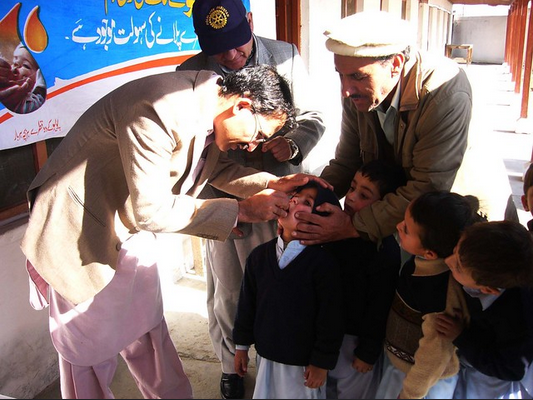
Vaccines 2023, 11(1), 70; https://doi.org/10.3390/vaccines11010070. Image credit: Ground Report via Flickr (CC BY-NC 2.0)
- Log in to post comments