










































WHO Tiered-Effectiveness Counseling Is Rights-Based Family
FHI 360, Durham, North Carolina (Stanback, Steiner, Dorflinger, Solo), Independent Consultant, Durham, North Carolina (Cates)
"Contraceptive effectiveness is the leading characteristic for most women when choosing a method, but they often are not well-informed about effectiveness of methods. Because of the serious consequences of 'misinformed choice,' counseling should proactively discuss the most effective methods - long-acting reversible contraceptives and permanent methods - using the WHO tiered-effectiveness model."
This Viewpoint article from Global Health: Science and Practice Journal argues for "proactive counseling based on the World Health Organization (WHO) tiered-effectiveness chart that begins with the relative effectiveness of various methods" as a way to provide informed family planning (FP) choice. It takes the position that counseling that does not focus on effectiveness may undermine rights-based approaches.
WHO guidance summarises findings of a technical consensus meeting on contraceptive choice and human rights and provides a conceptual framework for rights-based FP, particularly guiding scale-up of services. New studies have also emerged showing the effectiveness of long-acting reversible contraceptives (LARCs) in both developed and developing countries. For example, the St. Louis (Missouri, United States) CHOICE study gave women free contraceptives of their choice, and, at 3-year follow-up, "[n]on-LARC users in St. Louis were 20 times more likely to become pregnant in the next 3 years than LARC users."
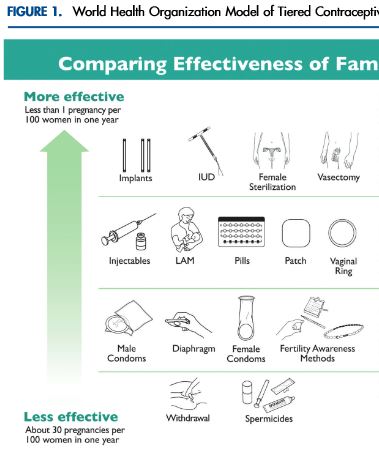
For this study, using the WHO "Model of Tiered Contraceptive Effectiveness" (figure 1 on page 3), trained counselors described the "full range of contraceptive methods and used internationally accepted counseling methods and tools....Within this framework of client-centered counseling, providers proactively spoke first about and emphasized the LARC methods of intrauterine devices (IUDs) and implants in the highest tier of contraceptive effectiveness. This counseling approach was dubbed 'LARC-first.'"
The authors recognise that "in some situations tiered counseling could become too directive, or perhaps even coercive", especially among vulnerable populations. However, they stress their perspective that: effectiveness should be the paramount characteristic emphasised in counseling. They begin from the premise of client autonomy in decisionmaking and recognise the values of safety and of accuracy of information in educating clients on choices. "Often, the absolute and relative effectiveness of different contraceptive methods are misunderstood by clients...", leading to misinformed choice, resulting in counseling that is not rights-based. Also impeding rights-based counseling is the problem of supply. If lack of supply leads to counseling and service delivery bias towards less effective methods, there is, again, a problem that is infringing on rights-based choice.
The authors conclude by emphasising a priority of increasing access to WHO tier-1 methods, along with accurate education about their advantages and disadvantages: "[A]ll methods of family planning, reversible and permanent, should be widely - indeed universally - available. Provision of these methods must include free choice, discontinuation on demand, and comprehensive counseling that proactively focuses on the WHO tiers of effectiveness. Until then, we are failing to accurately inform women with rights-based family planning programs."
Global Health: Science and Practice Journal, August 12 2015, accessed on August 31 2015.
- Log in to post comments