










































Tipping Point Social Norms Innovations Series
"People do not exist as islands; they make up a social system that is interdependent and built on tacit conventions of behavior....So then, how does one engage with social environments to shift what is considered 'normal'?"
The briefs in this series highlight innovations from CARE International's Tipping Point initiative, which aims to promote positive alternatives to child, early, and forced marriage (CEFM) for girls in Bangladesh and Nepal. (See Related Summaries, below.) The project is premised on the observation that change for gender justice requires more than sharing knowledge and promoting equitable attitudes of individuals; it also requires a society in which people's support for gender justice becomes normal and accepted. Tipping Point's social-norms-focused innovations complement a broader suite of activities to facilitate the agency and options of adolescent girls, working with girls, boys, parents, key formal and informal influencers, and local decision makers.
As outlined in each of the briefs, to guide and inform its work, Tipping Point distilled 8 design principles for engaging with social norms change, drawing from academic and gray literature on the topic. These include:
- Find early adopters: Often, people are already living their lives in positive ways that support girls' choices and opportunities. Find them.
- Build support groups of early adopters: It can be hard to embody positive, rights-based change alone. Groups help individuals support, encourage, and trouble-shoot.
- Use future-oriented positive messages: Help people imagine positive alternatives.
- Open space for dialogue: Challenge the implicit assumptions that everyone holds the same views, experiences, and preferences.
- Facilitate public debate: Engage publicly with community members to debate on what is okay in the context.
- Expect bystander action: Move from envisioning possibilities of justice to action. This involves building community and accountability, so that people show up for girls' rights in their words and actions.
- Show examples of positive behaviour in public: Demonstrate that the positive shift we hope for already exists and that it is normal.
- Map allies and ask for their support: Identify the needed resources and networks to support positive change for individuals, families, and communities.
The briefs include:
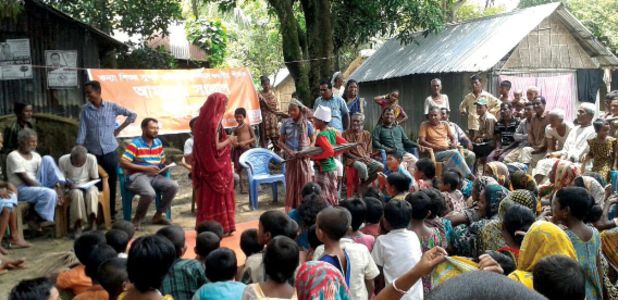
- Brief 1: Amader Kotha (Our Voice) [PDF] (Bangladesh) - Forum theatre is an entertaining, engaging, and interactive form of street theatre that enacts everyday situations to provoke discussion and promote social change. Having observed forum theatre that was performed by a professional group, some of the adolescent girls and boys participating in Tipping Point groups in Bangladesh wanted to do their own plays to promote adolescent girls' rights, showcase alternative possibilities, and publicly celebrate role models. To make the most of this opportunity, the Tipping Point team and the adolescents innovated by adding two other components based on the social norms programming principles and created a community talk show, which consisted of a theatre performance followed by a facilitated dialogue and debate on the theatre story themes.
- Brief 2: Football for Girls [PDF] (Bangladesh) - In rural communities in Bangladesh's Sunamganj district, adolescent girls are rarely seen spending free time outside their homes like boys, who play sports and meet for casual conversation. Tipping Point uses football to change social norms around girls in public spaces and the belief that girls cannot play sports. A team approach ensured that no girl would be alone as an early adopter. In one project area, an Islamic solidarity group organised an Islamic Jalsha (a religious gathering) and issued a fatwa (religious order) against the girls who played and their families, strictly prohibiting girls from playing. In response, CARE, partner organisations, athlete girls, and their families stepped in to advocate with their Local Elected Bodies (LEB), seeking their support to go forward with the final tournament of the girls' football competition.
- Brief 3: Amra-o-Korchi ("We Are Also Doing") [PDF] (Bangladesh) - Again in rural communities in Bangladesh's Sunamganj district, this campaign supported men and boys to take up tasks that are not typical for their gender. Men and boys took part in public competitions around cooking, stitching, and laundry. These small competitions culminated in a large public event, which saw men and boys go head to head to test their cooking skills.
- Brief 4: Tea Stall Conversations [PDF] (Bangladesh) - Fathers and brothers hold a great deal of power in the lives of adolescent girls in Bangladesh's Sunamganj district. For men and older boys, the tea stall is a common spot to socialise with peers. There, men gather to drink tea and discuss gender roles, girls rights, and CEFM with each other.
- Brief 5: Boys' Cooking Competitions [PDF] (Nepal) - Adolescent girls in the Terai region of Nepal where Tipping Point operates spend a great deal of their time engaged in household work - yime that might be spent studying for exams, doing schoolwork, or participating in other self-development activities. Together with the adolescents, the project team designed a boys' cooking competition to counter the notion that a domestic task, in this case cooking, is necessarily only a woman's job. They planned it for a public venue to demonstrate and normalise the sight of boys doing domestic labour. Making it a good-natured competition judged by the girls added an element of fun and celebration of experimenting with gender roles.
- Brief 6: Intergenerational Dialogues [PDF] (Nepal) - To foster parent-adolescent dialogue, the team started bringing together the project's adolescent groups with the parent groups once every three months for joint activities and discussions. When Mother's Day approached, they set up special games and conversation starters for mothers and daughters to do in pairs, which they did again for fathers and sons on Father's Day. Parents talked about their own childhoods, adolescents shared their hopes and dreams, and each pair discussed their expectations of one another. In this way, communication gaps between adolescents and their parents are bridged in order to better understand adolescents' aspirations.
- Brief 7: Raksha Bandhan [PDF] (Nepal) - The traditional ritual of a sister tying a thread around a brother's wrist and asking him for protection, which can reinfore patriarchal norms of male heroism and female supplication, is modified where brothers also tie a thread around their sisters' wrist and both vow to practice gender equality and pursue their dreams. After the ceremony, participants, parents, and village leaders held a dialogue on the idea that boys and girls could view each other as equals and support each other inside and outside the home.
- Brief 8: Street Drama [PDF] (Nepal) - Tipping Point's adolescent groups (both boys' and girls' groups) in Nepal became interested in street drama after some role plays they did within their groups. They felt it could be an effective way to raise sensitive topics in the community. The adolescent meetings provided a natural setting to develop scripts and scenes in the safety of the group. After initially performing plays that featured the deaths of child brides through early pregnancy and dowry violence, the players decided to refocus the narratives of their plays to highlight alternative outcomes for girls and boys with positive messages about young people's autonomy and capabilities, helping the audience imagine possibilities outside the norm. Shows were followed by adolescent-led discussions with the audience about the show's content, what audience members would change in the story, and how the story related to their own lives.
Each guide describes the approach underlying the project activities, as well as the results of qualitative research: Tipping Point staff developed inquiry questions based on CARE's Social Norms Analysis Plot (SNAP) framework to learn what contributions the Tipping Point intervention was having in terms of shifting social norms. SNAP examines any preliminary effects on:
- Empirical expectations: What I think others do.
- Normative expectations: What I think others expect me to do.
- Sanctions: Anticipated reactions of others whose opinions matter to me.
- Sensitivity to sanctions: How much sanctions matter for me.
- Exceptions: Under what situations is it acceptable to break the norms.
Quotes from community members are included to illustrate the impacts. Finally, an implementation guide at the end of each brief provides more details about the activity in question for the benefit of those seeking to replicate it in their own context.
Girls Not Brides website, March 1 2018.
- Log in to post comments